My Child Gets Angry
Every Time I Turn Off the Game
The meltdowns are not about the game. They are about what is happening neurologically when you interrupt a dopamine-fuelled reward loop mid-cycle.
anger at game shutdown
You have probably seen this before
You do not need to check every box. One is enough to know this page is for you.
Why Turning Off the Game Triggers Such an Intense Reaction
I'm Daniel Towle. I've been hooked by these games myself — I ran a gaming channel, played through the night, lied to myself about how long I'd been on for. When I checked the clinical criteria for gaming disorder, I realised they applied to me. That's what pushed me to understand what's actually happening in the brain when the game goes off.
The anger your child shows when the game goes off isn't defiance — it's a neurological withdrawal response. When you turn off a game, you're not just ending fun. You're cutting off a dopamine supply mid-flow. The brain reacts the way it would to any sudden loss — with frustration, distress, and sometimes aggression.
Games like Fortnite, Roblox, and Minecraft are built around variable reward schedules — the same mechanism that makes slot machines compelling. Every few seconds, something happens: a loot drop, a kill, a new discovery, a friend joining the server. Each one triggers a small dopamine release. Your child's brain adjusts to that rhythm. Interrupting it is like pulling the plug on a song mid-chorus — the brain expects the next beat and reacts when it doesn't come.
The anger is the gap between high-dopamine stimulation and whatever comes next — homework, dinner, bath. That gap is neurologically uncomfortable. For children whose prefrontal cortex (the part responsible for emotional regulation) is still developing, the discomfort comes out as rage, tears, or aggression. They're not choosing to be angry. Their brain is responding to a genuine chemical shift.
This is also why the anger tends to be worse in the evening. By 6pm, your child has spent all day regulating emotions at school. Their impulse control is depleted. Asking them to manage a dopamine crash on an empty willpower tank is asking for the worst version of the reaction.
But there's a deeper layer most advice misses entirely. The anger isn't just dopamine. Every time your child plays, they're in a world where they get to fight — and win. Not just against another player. Against what that player represents. Subconsciously, every opponent becomes a stand-in for the things that bother them in real life — the kid who was mean at school, the teacher who didn't listen, the situation where they felt powerless. Games offer something you almost never get in real life: the chance to beat the thing that's been hurting you, over and over. That feeling is powerful. And when you turn off the console, you're not just ending entertainment. You're taking away the one place where they feel like they're winning.
What the Anger Actually Looks Like — And What It Isn't
Gaming anger comes in different forms depending on your child's age, temperament, and the game they're playing. I see four common patterns — none of them mean your child is "broken."
The Explosive Reaction
Screaming, throwing controllers, slamming doors, hitting walls. This is the most alarming pattern — and the most common. It almost always happens mid-match, particularly in competitive games like Fortnite where the stakes feel real. The child is still in "fight mode" when the game ends, and the anger has nowhere to go.
The Verbal Lashing
"I hate you." "You're ruining my life." "I wish I didn't live here." These words are devastating to hear, but they're rarely about you. The child is experiencing a genuine emotional flood and directing it at whoever interrupted the dopamine supply. Five minutes later, many of them are mortified by what they said.
The Shutdown
Not all gaming anger is loud. Some children go completely silent — retreat to their room, refuse to eat, won't speak to anyone for hours. This pattern is more common in older children and teens. It looks like sulking, but it's often the same neurological distress expressed inward rather than outward.
The Negotiation Spiral
"Just one more match." "I'm about to rank up." "My friends will be angry if I leave." This is the mildest form, but it's often the hardest to deal with because it sounds so reasonable. The vocabulary expansion alone would impress their English teacher. Each argument works — unconsciously — to delay the dopamine crash. For children with ADHD, the need to finish can feel genuinely overwhelming.
None of these patterns mean your child has a character flaw. They mean the product they're using is optimised to resist interruption — and their developing brain doesn't have the tools to manage the transition smoothly.
Three Reactions That Guarantee a Bigger Explosion
There are three parent responses that consistently escalate gaming anger into something worse. Most families are doing at least one without realising it.
Matching Their Energy
When your child screams, the instinct is to shout back. But you're arguing with a brain mid-dopamine crash, not a rational person making a choice. Raising your voice during the crash phase guarantees a longer, louder meltdown — because you've added a threat response on top of a withdrawal response. Two fires, one room.
Pulling the Plug Without Warning
Walking over and turning off the console mid-game produces the maximum possible emotional reaction. You've simultaneously interrupted a dopamine loop, ended a social interaction with friends, killed progress they can't save, and removed their sense of control. Even adults would react badly to that combination.
Punishing the Anger Instead of the Behaviour
"If you're going to act like that, no gaming for a week." Punishing the emotional reaction teaches your child to suppress anger, not manage it. It also makes gaming the highest-value currency in your household — which guarantees bigger reactions when it's threatened. The anger is a symptom. Punishing symptoms doesn't fix causes.
There's a reason all three of these reactions come so naturally. You're too close to it. You're watching your child rage and you're thinking about their future — their grades, their friendships, their health. You want them to have a better life than you had. You want them to achieve, to be happy, to thrive. And you look at the games and you can see it clearly: this makes them happy right now, but not long term. The problem is, trying to explain long-term benefit to a child mid-dopamine crash doesn't land. They can't hear it. And your closeness — the love, the fear, the investment in their future — makes you the person who reacts the strongest. Which is exactly why the anger always ends up aimed at you.
How I Help Parents Deal With the Post-Game Rage
The families who stopped the cycle of gaming anger didn't get stricter or shout louder. They stopped fighting the symptom and started understanding the product. And the shift happened faster than most parents expect.
Most parents try the obvious things first: stricter rules, confiscation, shouting, caving in. None of those address why the anger happens. Every game — Fortnite, Roblox, FIFA — uses different mechanics to resist interruption. The pull is different for every game, and so is the approach. That's why generic advice doesn't work.
What I do with families is specific to their child and their game. I look at the exact mechanics keeping them hooked, the role the game plays in their social life, and what's driving the emotional response when it's taken away. Once you understand the full picture, the anger starts to make sense — and more importantly, it becomes something you can work with rather than fight against.
The families who stopped having gaming rage didn't find a better punishment. They found a different way to approach the problem entirely — one that's specific to their child and the game they're playing.
Here's what I've seen: Most families see the anger reduce significantly within two to three weeks. Not because the child suddenly develops perfect emotional regulation — but because the dynamic changes. The conversation shifts from confrontation to understanding, and that changes everything.
When Gaming Anger Is a Sign of Something Bigger
Most post-game anger is a normal neurological response. But some patterns indicate the problem has moved beyond typical transition difficulty. The NHS Every Mind Matters resource can help you assess where your family sits.
- Physical aggression: hitting, throwing objects, breaking things, or hurting siblings
- Threats of self-harm or running away when gaming is restricted
- The anger lasts hours, not minutes — and doesn't resolve on its own
- Your child has told you they know their reaction is wrong but can't stop it
- You feel unsafe or frightened during the outbursts
- The anger is getting worse over time, not staying the same
- Your child's mood is entirely dependent on gaming access
- They're losing friendships, sleep, or school performance because of gaming
- You've let them keep playing to avoid the outburst — and you know that's not sustainable
- Other family members are walking on eggshells around gaming time
- Notice whether the anger is specific to one game or happens with all screens — that distinction matters
- Pay attention to whether tiredness, hunger, or a bad day at school makes the reaction worse
- Ask yourself: is the anger getting worse over time, or has it always been this way?
I Know What the Pull Feels Like
I ran a gaming channel. I played through the night. I lied to myself about how long I'd been on for — sometimes I'd just lose track of time completely. I made friends online who I don't really have anymore — because we don't play those games anymore. I know what it's like to get caught up in a game's world, especially when your brain is wired for it. I'm currently waiting for my own ADHD diagnosis, and understanding why these games fulfil what they fulfil has been a big part of my own journey.
You can't approach gaming as a simple yes-or-no problem. You have to understand the subculture — why your child's friendships live inside the game, why the achievements feel real, why walking away feels like losing something. I spent 8 years as Head of Technology in London schools — including settings for children with ADHD and autism — and I saw this pattern over and over.
When your child rages at you for turning off the game, they're not showing you who they are. They're showing you what the product does to them. Understanding the pull — not punishment — is what changes the dynamic.
More from the Gaming Series
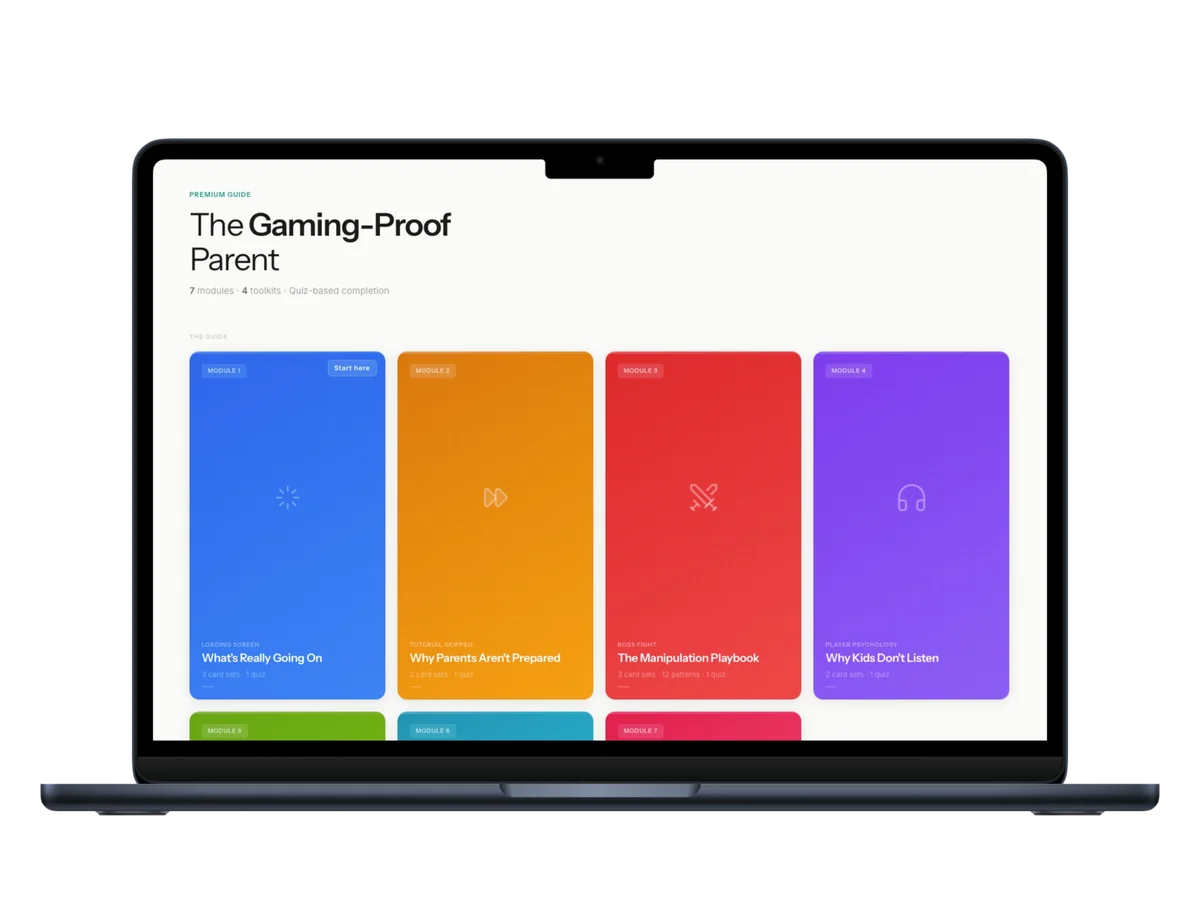
Every game your child plays is engineered to make stopping feel impossible. This guide breaks down exactly how — and gives you the conversations, the boundaries, and the 4-week plan to change it.
Want personalised help instead?
The guide gives you the system. A session gives you a plan built around your child, your family, and your specific situation. One call. 45 minutes. Everything changes.
Questions Parents Ask About Gaming Anger
Sources & Further Reading
- World Health Organization — Gaming Disorder (ICD-11, 6C51)
- American Academy of Pediatrics — Media and Children
- NHS Every Mind Matters — Is My Child Spending Too Much Time Online?
- The Washington Post — Kids, Parents & Tech Help (November 2025)