Is Fortnite Safe
for My Child?
“Just one more game” — the phrase that steals hours and triggers meltdowns. With over 400 million registered players, Fortnite is not just a game. It is a system built to keep your child playing.
accounts
You have probably noticed something
You do not need to check every box. One is enough to know this page is for you.
Is Fortnite safe for kids? (2026)
For ages 13+ with parental controls engaged, yes. Fortnite is rated PEGI 12 in the UK and ESRB T (Teen 13+) in the US. Common Sense Media also recommends 13+ due to action violence and open chat. The biggest risk is not the violence — it's the live voice and text chat with strangers. Under-13 accounts on Epic Games are automatically “Cabined” with chat and purchases disabled until a parent approves.
What Is Fortnite and Why Is It So Popular?
Fortnite is a free-to-play battle royale game where 100 players compete to be the last one standing. It is rated 12+ by PEGI, but millions of younger children play it. The game makes money through cosmetic purchases (skins, emotes) — not by charging to play. This “free” model is precisely why it is so addictive.
Unlike games you buy once and own, Fortnite keeps players coming back daily. The World Health Organisation now recognises gaming disorder as a mental health condition — and games like Fortnite exhibit many of the psychological hooks that contribute to compulsive play.
Why Can't My Child Stop Playing Fortnite?
Fortnite’s design makes stopping difficult. Variable reward schedules, battle pass progression, and 20-minute match lengths create artificial urgency and constant dopamine hits. Former Google Design Ethicist Tristan Harris describes how tech companies use “addiction and manipulation” by design. Your child is not weak; they are fighting game design built by hundreds of psychologists.
Variable Rewards
Every match has an unpredictable outcome. This uncertainty triggers dopamine — the same mechanism that makes gambling addictive. “One more game” feels compelling because the next match might be “the one.”
FOMO (Fear of Missing Out)
Limited-time skins, seasonal events, and battle passes create artificial urgency. If your child does not play NOW, they will miss out forever — or so the game makes them feel.
Social Pressure
“Everyone at school has the new skin.” Fortnite is not just a game — it is a social space where exclusion feels real and painful.
Competitive Ranking
The ranking system creates a treadmill effect. Lose a match, drop in rank, feel compelled to play again to recover. Stopping feels like losing.
Is Fortnite Safe for Kids?
Fortnite can be made reasonably safe with proper setup — but “safe” depends entirely on your settings and involvement. Voice chat with strangers, spending pressure, and addictive design are the real risks. The 12+ rating exists for good reason.
Voice Chat with Strangers
By default, your child can talk to anyone in squad modes. This is the single most important setting to change — disable voice chat entirely or set to friends-only before they play.
Spending Pressure
V-Bucks, Battle Passes, and limited-time skins create constant spending temptation. Children do not intuitively understand digital currency value. Remove payment methods and use prepaid cards only.
Addictive Design
The variable rewards, FOMO mechanics, and competitive ranking are optimised for maximising playtime. This is not accidental — it is the business model.
Why Does My Child Get Angry When I Turn Off Fortnite?
It is not just about stopping a game — it is about interrupting a social experience and triggering dopamine withdrawal. Your child might be mid-match with friends, about to level up, or in a ranked game where leaving means penalties. The anger is not defiance; it is the game’s design working exactly as intended.
The social dimension. Fortnite is not solitary — your child is often playing WITH friends. When you say “time to stop,” you are not just ending a game; you are pulling them out of a social gathering.
The dopamine crash. Gaming floods the brain with dopamine. Stopping abruptly creates a crash. A longitudinal fMRI study (2025) found 72-hour screen restriction showed brain activity changes “that may reflect withdrawal-related processes.” The irritability is neurochemical, not personal.
Agree on stopping points before play starts (“after this match,” not “in 20 minutes”). Give 10-minute warnings. Never interrupt mid-match if possible. These small changes can transform daily battles into manageable transitions.
How Do I Set Up Fortnite Parental Controls?
Epic Games provides robust parental controls — but they are useless if you do not know they exist, and most parents do not. The Cabined Account feature is particularly powerful for under-13s.
Create a Cabined Account (Under 13)
Choose “Cabined Account” when setting up. This restricts voice chat, text chat, purchases, and friend requests until you unlock them.
Set Up a PIN
Create a 6-digit PIN in Parental Controls. This prevents your child from changing settings or making purchases without approval.
Disable Voice Chat
Settings → Voice Chat → Off or Friends Only. This is the single most important safety setting.
Restrict Friend Requests
Set to “Nobody” or “Friends of Friends.” Prevents random players from adding your child.
Enable Playtime Reports
Epic will email you weekly playtime summaries. This creates accountability and helps you spot patterns.
Disable Auto-Fill Squads
In the game lobby, disable “Fill” in squad modes. Prevents matchmaking with strangers.
I know why your child can't stop
I would not start my day until I had won a competitive game. Sometimes that took 7 or 8 matches. Hours would disappear before I had even “begun” my day. I would be only 5 metres from my partner, but I was in a completely different world. The 20-minute match length is perfectly designed: short enough to justify one more, long enough to steal your entire evening.
Daniel Towle — Screen Time Specialist, Washington Post FeaturedWhat Age Is Appropriate for Fortnite?
PEGI rates Fortnite 12+ for mild violence, but the real considerations are psychological maturity, emotional regulation, and ability to handle the spending pressure. Under 10: strongly consider waiting. Ages 10-12: Cabined account mandatory, heavy restrictions, supervised play. Ages 13+: more independence with clear, enforced boundaries on spending and time.
What actually works depends on your child’s maturity (some 11-year-olds handle Fortnite better than some 14-year-olds), what has already happened (if gaming is already a problem, you need a different approach), whether they have ADHD or autism (the dopamine hit from competitive play is more intense for neurodivergent children), and your family’s communication style.
What the Data Actually Shows
Insights from Daniel’s 12 years working in London schools
Is My Child Addicted to Fortnite?
Not every child who loves Fortnite is addicted. But if gaming is causing regular distress, affecting school, sleep, or relationships, and they genuinely cannot stop despite wanting to — these are warning signs. The key question: is Fortnite enhancing their life or taking from it?
- Physical aggression when gaming is interrupted
- Threats of self-harm related to gaming restrictions
- Complete social isolation — refusing school or friends
- Failed attempts to reduce despite consequences
- Extreme reactions to stopping — rage, tears, shutdown
- Declining school performance
- Sleep disruption — playing late, tired during day
- Deceptive behaviour about gaming time
- Loss of interest in other activities
- Mild disappointment when stopping but transitions OK
- Maintains other interests alongside gaming
- Honest about play time
- Responds to limits when set consistently
More from the Gaming Series
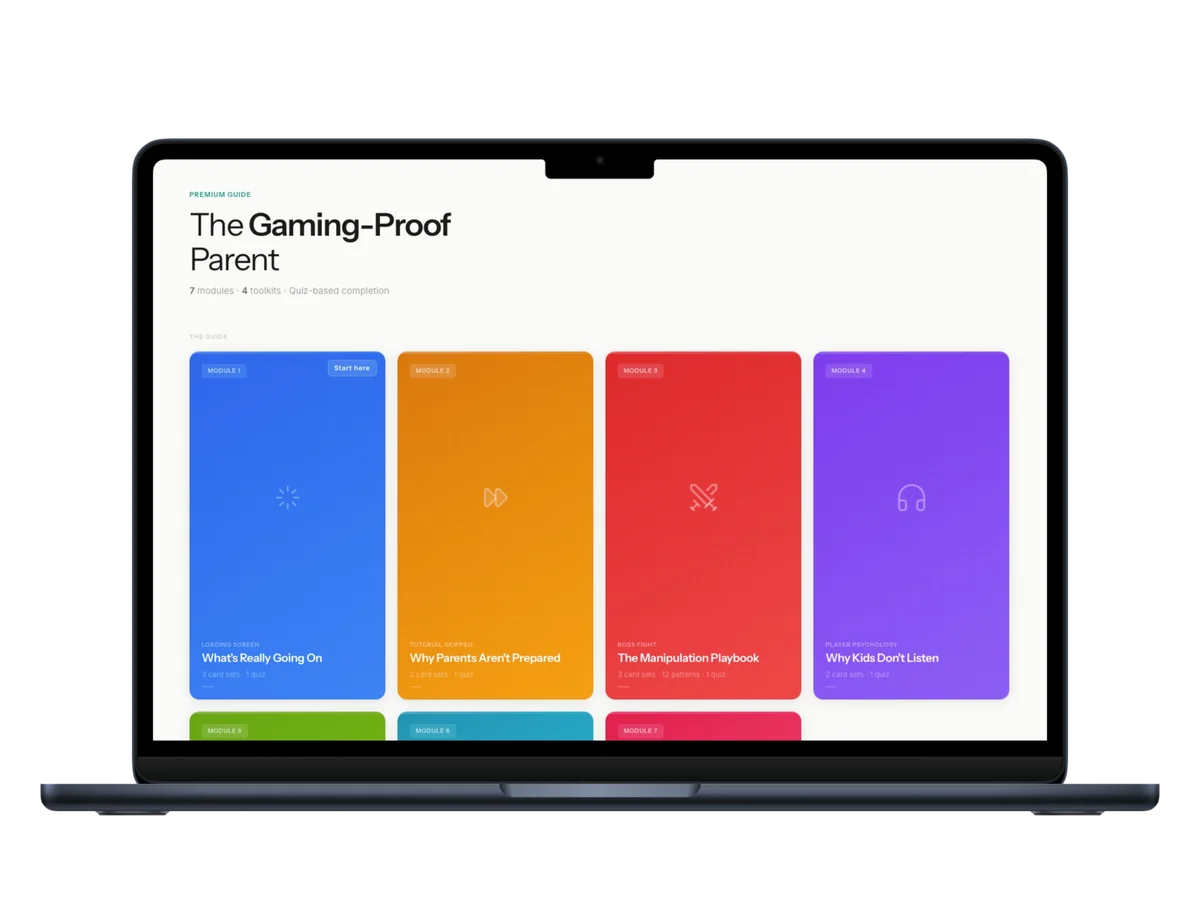
Every game your child plays is engineered to make stopping feel impossible. This guide breaks down exactly how — and gives you the conversations, the boundaries, and the 4-week plan to change it.
Want personalised help instead?
The guide gives you the system. A session gives you a plan built around your child, your family, and your specific situation. One call. 45 minutes. Everything changes.
Your Questions Answered