Is Minecraft Safe
for My Child?
Often seen as the “safe” option. But with 170+ million monthly players, multiplayer servers, mods, and chat features create risks most parents do not expect. Minecraft is built to be played forever — with no natural stopping point.
worldwide
You have probably noticed something
You do not need to check every box. One is enough to know this page is for you.
Is Minecraft safe for kids? (2026)
Yes — Minecraft is one of the safer mainstream games for children, especially in single-player or Creative mode. It is rated PEGI 7 in the UK and ESRB E10+ (Everyone 10+) in the US. Minecraft's terms of service require parental consent for users under 13. The risks show up almost entirely in public multiplayer servers — strangers, swearing, bullying — not in the core game itself.
What Is Minecraft and Why Is It So Popular?
Minecraft is a sandbox game where players mine resources, craft tools, and build anything they can imagine. It is rated PEGI 7+ and ESRB E10+, making it one of the more age-appropriate gaming options. The game has genuine educational potential — creativity, problem-solving, spatial reasoning. But it is also built to be played forever, with no natural stopping point. That is where problems begin.
Unlike games with levels and endings, Minecraft is deliberately endless. There is always more to mine, more to build, more to explore. This openness is what makes it creative — but also what makes “just five more minutes” so common. Understanding this design helps you understand why your child struggles to stop.
Java vs Bedrock: Which Version Does Your Child Have? There are two main versions with very different parental control options. Bedrock Edition (consoles, mobile, Windows 10/11) has better built-in parental controls through Microsoft Family Settings. Java Edition (PC only) offers more flexibility but is significantly harder to control. Many parents do not realise which version they are using — and this affects what safety measures are possible. The right setup makes a real difference — and it is easier than you think.
Is Minecraft Safe for Kids?
Is Minecraft safe for kids? Yes and no. Minecraft is one of the safer options — rated PEGI 7+, genuinely creative, with real educational value. But “safe” depends on how it is used. Single-player is low-risk. Public servers expose children to strangers and scams. The endless design creates compulsive patterns, especially in ADHD and autistic children — there is no natural stopping point.
Whether Minecraft is bad for kids depends almost entirely on how it is used. Safety depends on platform (Java vs Bedrock), play mode (single-player vs multiplayer), and whether you are involved. With the right setup, Minecraft can be genuinely beneficial. Without it, even this “safe” game creates problems.
What Are the Dangers of Minecraft?
Parents ask whether Minecraft is dangerous, and the honest answer is: not in the way most people fear. The main risks are addiction (no stopping point), unsafe multiplayer servers, chat with strangers, inappropriate third-party content (mods, YouTube), and in-game spending on the Marketplace. For neurodivergent children, the repetitive loop can be particularly gripping. The game itself is relatively safe — the risks are in how it is used and accessed.
No Natural Stopping Point
Unlike games with levels or endings, Minecraft’s mine-craft-build cycle repeats forever. This is particularly challenging for children with ADHD or autism, where the repetitive loop can trigger hyperfocus that makes stopping genuinely difficult.
Multiplayer Server Risks
Public servers mean strangers. Many servers have chat where unknown people can communicate with your child. “Griefing” (destroying others’ builds) is a form of online bullying. Some servers host inappropriate content.
Mods and Third-Party Content
Mods can contain malware, inappropriate content, or security risks. Third-party download sites are particularly risky. Minecraft YouTube often leads to inappropriate content or unsuitable language for younger viewers.
Marketplace Spending
Minecoins let players buy skins, worlds, and add-ons. While less predatory than Roblox’s model, there is still pressure to buy what friends have. If payment methods are connected, spending can happen fast.
Here is what gives me hope: Minecraft is one of the few games where the educational benefits are real — when set up correctly. Every family I have worked with who has configured the right controls has found a healthy balance. The key is getting the multiplayer and chat settings right from the start.
Why Can’t My Child Stop Playing Minecraft?
Minecraft is designed with no natural stopping point — no levels to complete, no final boss, no “game over.” The mining-crafting-building loop creates continuous small rewards that trigger dopamine hits. Your child is not weak; they are responding to deliberate design. This is especially true for ADHD and autistic children, where the repetitive loop can trigger hyperfocus.
The Endless Loop
Mine resources, craft tools, build structures, explore further, mine more. Every session can extend indefinitely because there is always one more block to mine, one more thing to build.
Continuous Dopamine
Every block mined, every item crafted, every structure built triggers a small reward. Unlike games with gaps between rewards, Minecraft provides constant micro-hits.
ADHD and Autism Factor
The repetitive loop is specifically engaging for ADHD and autistic brains. Combined with no natural stopping points, it creates a perfect storm for hyperfocus that makes stopping genuinely difficult — not because they lack willpower.
No Save Points
“Just let me finish this” is almost impossible to honour because there is always something else to finish. The game will never signal “time to stop” for you.
Why Does My Child Get Angry When I Turn Off Minecraft?
When you turn off Minecraft, you are interrupting a dopamine-driven flow state with no warning from the game itself. Your child was mid-build, mid-mine, mid-task — and now they are cut off without the satisfaction of completion. The anger is a genuine stress response, not defiance.
The dopamine crash. Gaming floods the brain with dopamine. Stopping abruptly creates a crash. The irritability is neurochemical, not personal.
No natural break points. Unlike Fortnite (20-minute matches) or Roblox (individual games), Minecraft has zero built-in stopping cues. There is no “match over” moment. The game actively works against your time limit.
Give 15-minute, 10-minute, and 5-minute warnings. Negotiate stopping points in advance (“when you finish this build” or “when you find diamonds”). For children with ADHD, external time cues are essential because their internal sense of time is already disrupted.
How Do I Set Up Minecraft Parental Controls?
Minecraft’s controls depend heavily on which version you have. Bedrock Edition (console, mobile, Windows 10/11) uses Microsoft Family Settings for time limits, multiplayer restrictions, and chat controls. Java Edition (PC) has fewer built-in controls and requires more manual oversight.
Set Up Microsoft Family Settings
Create a Microsoft account for your child and add them to your family group. This gives you access to screen time limits, content filters, and activity reports across all their devices.
Configure Multiplayer Access
Decide whether they can play with others. Options range from “no multiplayer” to “friends only” to “open servers.” For younger children, “friends only” or private Realms are safest.
Manage Chat Settings
Text chat can be disabled entirely, limited to friends, or left open. Voice chat requires additional platform-level controls (Xbox, PlayStation, etc.).
Control Marketplace Purchases
Require approval for all purchases. Better yet, do not link payment methods — use pre-paid Minecoin cards instead for managed spending.
You have now got the technical setup sorted. But here is what I have learned from helping families — and where I come in:
- ✕ Create a natural stopping point — Minecraft is designed without one. There is always more to mine, more to build, more to explore. Controls can limit time, but they cannot make stopping feel natural.
- ✕ Address hyperfocus patterns — For children with ADHD or autism, the repetitive loop triggers a brain state that makes disengagement genuinely difficult. Settings do not change neurology.
- ✕ Make “five more minutes” mean five minutes — When they are mid-build or mid-mine, the perception of time changes. Warnings do not work when they genuinely believe they will “just finish this bit.”
- ✕ Transform consumption into purposeful play — Endless mining is not education. Controls restrict access but do not teach your child how to use Minecraft productively.
- ✕ Teach self-regulation — Controls restrict. They do not teach. When controls come off — and eventually they will — old patterns return unless your child has learned to manage themselves.
The setup above covers the 5%. If you have tried controls before and they have not worked, or if your child has ADHD/autism and needs a different approach — that is the other 95%. Book a session — £75 / $95, no waiting list.
The ADHD and autism problem
I worked with neurodivergent children in schools for over a decade. Minecraft hits these kids differently. The mining-crafting-building cycle triggers continuous dopamine hits. Combined with no natural stopping point, it creates hyperfocus that makes stopping genuinely difficult — not because they lack willpower, but because of how their brains respond to this specific design.
Daniel Towle — Screen Time Specialist, Washington Post FeaturedIs Minecraft Multiplayer Safe?
Minecraft multiplayer can be safe — but only with the right setup. Private Realms with approved friends are genuinely low-risk. Public servers are where the problems start: unmoderated chat, griefing, inappropriate builds, and contact with strangers. The version matters too — Bedrock Edition has better built-in multiplayer controls than Java. Most parents do not realise how different these two experiences are.
Private Realms vs Public Servers. Whether Minecraft multiplayer is safe depends on which type. Realms are Minecraft’s official private servers. You control who joins. Chat is limited to approved players. This is the safest multiplayer option and works well for playing with school friends. Public servers, on the other hand, can expose children to unfiltered content, toxic chat, and adults posing as younger players. Many popular servers have their own moderation, but it is inconsistent.
Java vs Bedrock: Which Is Safer Online? Bedrock Edition (consoles, mobile, Windows 10/11) integrates with Microsoft Family Settings, giving parents real control over who their child plays with, whether chat is enabled, and what content they can access. Java Edition has no built-in parental controls for multiplayer — once they are on a server, you are relying on that server’s moderation. For families concerned about online safety, Bedrock is the better choice.
Not sure which version your child uses? In a 45-minute session, I will help you audit their current setup and configure the right multiplayer settings for your family — £75 / $95, no waiting list.
What Age Is Minecraft Appropriate For?
Minecraft is rated PEGI 7+ and ESRB E10+, but maturity for managing endless gameplay matters more than content ratings. Under 8: supervised play in Creative mode, no multiplayer. Ages 8-12: more independence with clear boundaries — parents often ask whether Minecraft is safe for 10 year olds specifically, and at this age it can be genuinely educational. Ages 13+: more freedom possible, but ADHD kids may still need support.
Remember: age is one factor. How your specific child responds to Minecraft — especially if they have ADHD or autism — matters more than hitting a number.
The age recommendations above are general guidelines. What actually works depends on your child’s maturity (not just their birthday), what has already happened (prevention looks different from intervention), whether they have ADHD or autism (the endless loop hits neurodivergent children harder), and your family’s communication style (rules that work for some families backfire in others).
Whether Minecraft is good for kids with ADHD has no simple answer. The repetitive cycle — mine, craft, build, repeat — triggers hyperfocus patterns that make stopping extremely difficult. I spent 12 years working with neurodivergent children in schools and saw this pattern repeatedly. The standard advice does not apply. If your child has ADHD or autism, the approach needs to be tailored to how their brain works, not generic age brackets. This is exactly what I help with.
What the Data Actually Shows
Insights from Daniel’s 12 years working in London schools
Is Your Child’s Minecraft Use a Problem?
Some Minecraft play is normal and healthy. The concern is when it starts affecting other areas of life. Watch for hours passing without awareness, anger when asked to stop, playing before school or during meals, lost interest in other activities, and secretiveness about servers or YouTube content.
- Physical aggression when Minecraft is interrupted
- Complete social isolation — refusing school or friends
- Playing through the night, unable to stop
- Failed attempts to reduce despite consequences
- Extreme reactions to stopping — rage, tears, shutdown
- Declining school performance
- Sleep disruption — playing late, tired during day
- Deceptive behaviour about gaming time or servers
- Lost interest in activities they used to enjoy
- Mild disappointment when stopping but transitions OK
- Maintains other interests alongside gaming
- Honest about play time and what they do online
- Responds to limits when set consistently
Signs to Watch For
Early Warning Signs
Serious Concerns
If you ticked 3 or more, it is time to take action. The good news: this is fixable with the right approach.
Is Minecraft good for a child with ADHD or autism?
Often, yes. For a lot of ADHD and autistic children, Minecraft is one of the better things they can be doing on a screen: open-ended creative play, no fixed end-state to chase, predictable rules, and a sandbox where hyperfocus turns into something they actually build. The catch is not the game. It is the transition off it, and the multiplayer servers and voice chat they wander into. Get those two things right and Minecraft is usually a keeper, not a problem.
As someone who is autistic and ADHD myself, I get why this game lands the way it does. Minecraft does not punish you for playing “wrong.” There is no clock, no losing, no one telling you the goal. The rules are consistent, so you always know what a block will do, and that predictability is calming when the rest of the world is not. Creative mode in particular can be a genuinely regulating, low-stimulation space — a quiet place to build for an hour rather than a feed designed to keep you scrolling. The kids I taught who struggled to sit still for anything would build cathedrals, redstone machines and working maps, brick by brick. That is not wasted time. That is sustained focus, spatial reasoning and planning, which is exactly the skill set school keeps telling them they do not have.
Here is the honest watch-out, though, and it is the same one I live with. The thing that makes Minecraft good for these brains, hyperfocus, is also what makes coming off it so hard. The meltdown at the end of a session is almost never about the game itself. It is the transition: being yanked out of a flow state with no natural stopping point and no warning the brain could plan around. If you read the anger as defiance you will fight the wrong battle. The other real risk is not the building at all, it is who they are building with. Public multiplayer servers and open voice chat are where strangers, unmoderated chat and inappropriate content actually show up. The single-player sandbox is the safe part. For more on why this pattern hits differently, see how ADHD and screen time interact.
My instinct is never to ban a game that is genuinely good for a child’s brain. The work is structure around the edges: a predictable wind-down so the transition off it does not become a fight, and being deliberate about which servers and whether voice chat is on. Fix the transition and the servers, and you usually get to keep the good bits of Minecraft without the meltdowns.
Daniel Towle — Screen Time Specialist, autistic and ADHD, 12 years in schoolsParental controls will not fix this.
Find out what will.
Most parents set restrictions and hope for the best. But in my experience, controls are only about 5% of the solution. Take the 2-minute assessment to see what is really going on.
Take the Gaming QuizMore from the Gaming Series
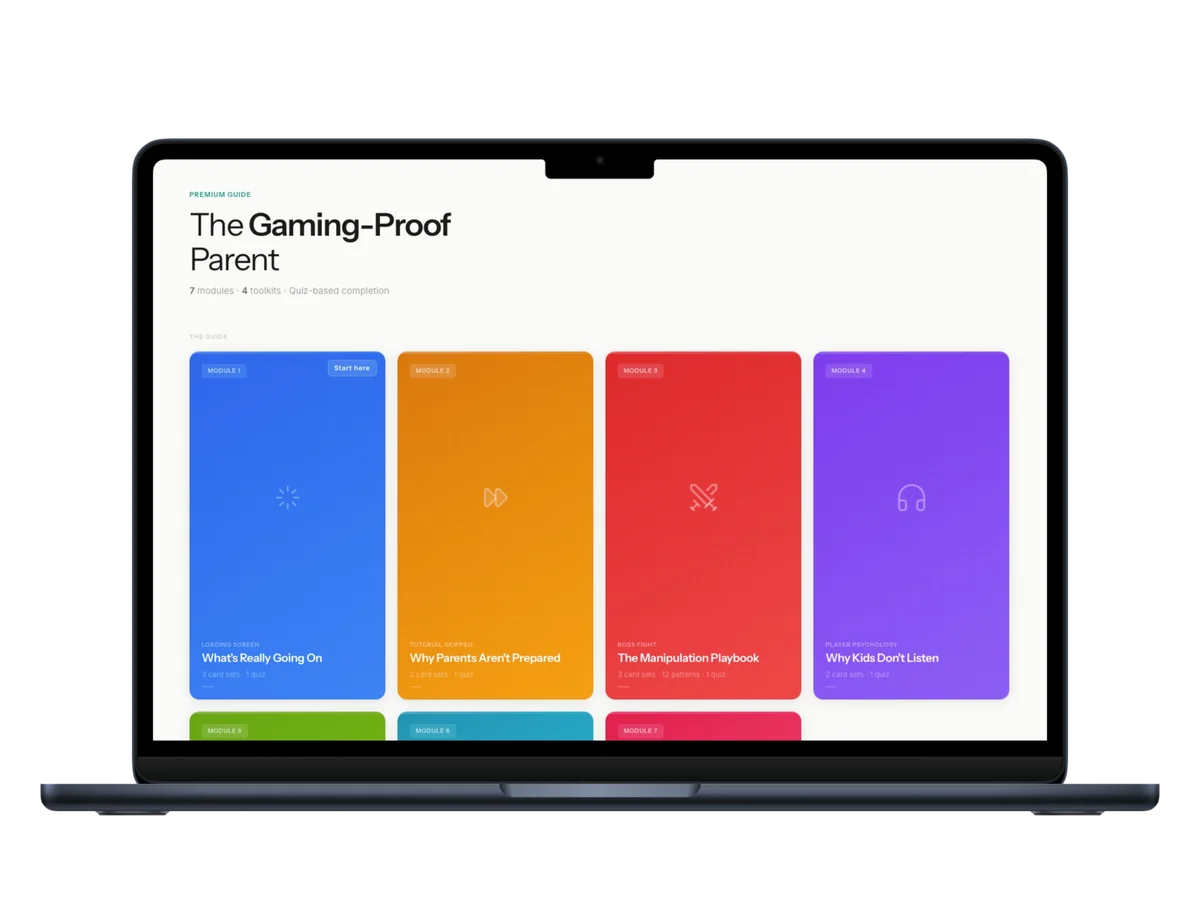
Every game your child plays is engineered to make stopping feel impossible. This guide breaks down exactly how — and gives you the conversations, the boundaries, and the 4-week plan to change it.
Why Don’t My Limits Work with Minecraft?
If you have set time limits and they are not working, it is not because you are doing something wrong. Minecraft has no natural stopping points — there is always more to mine, more to build. Limits restrict WHEN they play but do not teach them HOW to stop. That is why, in my experience, controls are only about 5% of the solution.
Why Time Limits Alone Do Not Work. You have probably tried setting limits — 30 minutes, an hour, whatever feels reasonable. And it probably led to arguments. That is because Minecraft has no natural stopping point. The limit interrupts mid-flow, mid-build, mid-mine. Your child is not lying when they say “just five more minutes” — they genuinely believe they are almost done. The issue is not your limit. It is that Minecraft never feels finished.
Why Earned Screen Time Backfires. Using Minecraft as a reward for homework or chores seems logical — but it increases the craving. It also sends an unintended message: the thing you REALLY want is Minecraft, and everything else is just the price you pay to get it. This makes the game feel even more valuable and other activities feel like obstacles. Consider separating them entirely — Minecraft happens (with limits), but it is not contingent on other tasks.
Why Cold Turkey Causes Meltdowns. It seems logical: time is up, game goes off. But when you remove Minecraft mid-flow, you have cut off the dopamine without warning. The brain has not had time to transition — which is why the reaction is so disproportionate. It is not defiance; it is a neurological response. Gradual wind-downs, agreed end points, and warnings before stopping give the brain time to prepare.
Why Willpower Is Not the Issue. Minecraft’s repetitive loop — mine, craft, build, repeat — holds attention. For ALL children, stopping requires interrupting a flow state the game actively creates. For children with ADHD or autism, this is even harder: the loop triggers hyperfocus, a brain state that makes disengagement genuinely difficult. This is not a lack of willpower — it is how the game interacts with the brain. These children need strategies, not blame.
How Can I Help Your Family with Minecraft?
In a 45-minute session, I help you understand why Minecraft has such a grip on your child, set up the right version with appropriate controls, create boundaries that work for your specific child, and develop strategies for the “just five more minutes” problem — with extra attention if your child has ADHD or autism.
Understanding the Pull
Why Minecraft specifically has such a grip. The “no natural stopping point” problem. For ADHD/autistic children — why they struggle more than others, and why that is not their fault.
Finding the Balance
When Minecraft is helping your child vs hurting them. The difference between purposeful play and mindless consumption. How to shift from one to the other.
Practical Setup
The right version for your situation. Multiplayer decisions that make sense. Controls that actually work. Handling the YouTube Minecraft content problem (it is a separate issue).
The Conversation
How to set limits without daily battles. What to say when “just five more minutes” does not work. Building stopping strategies that work for YOUR child.
What you will leave with: A personalised action plan, realistic expectations, extra strategies if your child has ADHD or autism, and follow-up support if you need it. Book your session — £75 / $95
Is Minecraft Your Only Concern?
Whether it is Minecraft, Roblox, Fortnite, or TikTok — the underlying patterns are similar. Minecraft is actually one of the safer options compared to platforms like Roblox (more significant predator concerns) or Fortnite (more aggressive spending pressure). But all of them require boundaries and conversation.
If you are dealing with screen time challenges beyond Minecraft, my hub pages cover the full spectrum:
- Gaming — for broader gaming concerns
- Screen Time Help — for general device management
- Social Media — for TikTok, Instagram, and phone dependency
The fundamental skill I teach — setting boundaries that actually work, having conversations that do not end in arguments, understanding why your child struggles — applies across all platforms.
Want personalised help instead?
The guide gives you the system. A session gives you a plan built around your child, your family, and your specific situation. One call. 45 minutes. Everything changes.
Your Questions Answered