Is TikTok Safe
for My Child?
68% of teens use it. The algorithm forms habits in 35 minutes. Endless scroll, mental health content, challenge trends, and a recommendation engine that learns exactly what keeps them watching.
use by UK teens
You have probably noticed something
You do not need to check every box. One is enough to know this page is for you.
Is TikTok safe for kids? (2026)
No — not for anyone under 13, and only with active supervision for teens. TikTok's minimum age is 13. Amnesty International's 2023 technical research found that after just 5–6 hours on the platform, 1 in 2 videos shown to a new account were mental-health-related — including pro-anorexia and self-harm content. 5Rights Foundation research documented that over 30% of content normalising child sexual abuse was slipping through TikTok's own filters at the time of publication.
Is TikTok Safe for Kids?
No — TikTok is not safe for kids. The platform’s own internal research shows it creates compulsive usage within 35 minutes. Children are exposed to inappropriate content, algorithm-driven addiction, mental health rabbit holes, and predator contact. Even with parental controls, the core design prioritises engagement over safety. I got hooked on it myself while trying to help parents — that is how effective it is.
The Kentucky lawsuit revealed internal ByteDance documents showing they knew about these risks. Their own research showed “compulsive usage correlates with loss of analytical skills, memory formation, contextual thinking, conversational depth, empathy, and increased anxiety.” The algorithm does not distinguish between child-safe and harmful content — it serves whatever keeps users watching.
Why Is TikTok So Addictive?
TikTok’s algorithm is the most sophisticated recommendation engine ever built for short-form video. It does not need your child to follow anyone — it learns exactly what triggers their brain within 35 minutes. Aza Raskin, who invented infinite scroll, describes this design as “behavioural cocaine” sprinkled over every interface.
Internal documents from TikTok’s parent company ByteDance reveal they knew about the addiction risks. The Kentucky lawsuit uncovered their own research showing “compulsive usage correlates with loss of analytical skills, memory formation, contextual thinking, conversational depth, empathy, and increased anxiety.” Yet the core design remains largely the same.
Unlike YouTube where you choose what to watch, TikTok’s For You Page does the choosing. It watches how long your child pauses, which videos they rewatch, what makes them scroll faster. Within an hour, it knows your child better than most apps ever will — and it optimises ruthlessly for engagement, not wellbeing.
What Are the Dangers of TikTok for Kids?
The main dangers are algorithm addiction, exposure to inappropriate content, mental health rabbit holes, dangerous challenges, and contact from strangers. TikTok’s algorithm is particularly effective at trapping vulnerable users in harmful content loops.
Algorithm Addiction
TikTok’s internal research, revealed in the Kentucky lawsuit, shows the app can hook users in under 35 minutes. The infinite scroll means there is no natural stopping point — unlike a TV episode or book chapter.
Mental Health Rabbit Holes
The algorithm creates “filter bubbles” that can trap users in harmful content loops. If your teen is feeling low, the algorithm serves more sad content. The effect is that emotional vulnerability drives more engagement.
Inappropriate Content
Despite moderation, concerning content slips through constantly. Sexual content, violence, misinformation, dangerous “challenges” — TikTok’s volume makes comprehensive moderation impossible.
Body Image and Self-Esteem
TikTok’s algorithm promotes “attractive” users and demotes those it deems less attractive. Beauty filters create unrealistic standards. Research shows 24% of girls exceed the 2-hour daily risk threshold compared to 15% of boys.
Attention Span Damage
Short-form content is rewiring how young brains process information. TikTok’s own internal research acknowledged “loss of analytical skills, memory formation, contextual thinking.” After heavy TikTok use, longer content — books, films, even conversations — feels boring by comparison.
Predator Contact and Sextortion
I created a video to help teens and parents with sextortion. Most of my comments were from fake accounts claiming they would help — when actually they were more likely to be people who DO sextortion. Reports to TikTok came back “not violated terms of service.”
Here is what gives me hope: Every family I have worked with who has set clear TikTok boundaries has seen improvements within 2-3 weeks. The mood swings reduce, the arguments decrease, and your child starts re-engaging with the real world. It is not easy — but it works.
Why Can’t My Child Stop Using TikTok?
TikTok’s algorithm learns exactly what triggers your child’s brain and serves an endless stream of it. Your child is not weak — they are facing technology built to be irresistible. Former Google Design Ethicist Tristan Harris describes how social media uses “your psychology against you.” The app creates dopamine spikes with every video, followed by crashes that make them crave more.
Unlike YouTube where you choose what to watch, TikTok’s For You Page does the choosing. It watches how long your child pauses, which videos they rewatch, what makes them scroll faster. The infinite scroll has no natural stopping point — no “end of episode” moment that signals time to stop. Every video is optimised to keep them watching just one more. And every video teaches the algorithm more about what keeps your child watching.
Why Does My Child Get Angry When I Turn Off TikTok?
The anger is a withdrawal response — their brain is protesting the sudden cut to its dopamine supply. When you turn off TikTok, you are not just ending entertainment; you are interrupting a chemical process. A longitudinal fMRI study (2025) found screen restriction triggers brain activity changes “that may reflect withdrawal-related processes.” It is not defiance; it is their brain chemistry adjusting.
The meltdowns, the screaming, the “I hate you” — these are not character flaws. TikTok has trained their brain to expect constant stimulation. The infinite scroll creates micro-dopamine hits every few seconds. When that stops abruptly, their brain experiences genuine distress.
This does not mean you should give in — it means the approach matters. Gradual wind-downs, transition warnings, and addressing the underlying dependency all help reduce the intensity of these responses. Agree on stopping points before use starts.
How Do I Set Up TikTok Parental Controls?
TikTok’s Family Pairing feature lets you link your account to your child’s and control time limits, content filters, DMs, and search. It is worth setting up — but a systematic review of 40 studies found parental controls produce “null or even adverse effects” in many cases. In my experience, controls are about 5% of the solution.
Enable Family Pairing
On your TikTok account, go to Settings → Family Pairing → Continue. This generates a QR code. On your child’s phone, scan this code to link the accounts together.
Set Daily Screen Time Limits
Choose a daily limit (I recommend starting with 60 minutes for teens). When time is up, a passcode is required to continue. Your child can request more time, which you approve or deny from your phone.
Enable Restricted Mode
This filters some mature content — but do not rely on it alone. TikTok’s volume means concerning content still slips through. Think of it as a first line of defence, not complete protection.
Control Direct Messages
For under-16s, set DMs to “No one” or “Followers you follow back.” This prevents strangers from contacting your child directly — a key protection against predators.
Limit Search
You can restrict what your child can search for on TikTok, preventing them from actively seeking inappropriate content even if it is not appearing in their feed.
That is the 5% sorted. If you have tried Family Pairing before and it has not worked — or you want to skip straight to what actually changes behaviour — that is the 95% I help with. Book a session — £75 / $95
What Age Should My Child Get TikTok?
TikTok’s minimum age is 13, but many experts recommend waiting until 15-16. The algorithm is particularly effective at capturing young users, and mental health risks are highest for pre-teens. If your child is under 13 and already using it, we can discuss harm reduction strategies in a session.
Under 13 — Not Recommended
Violates TikTok’s own terms of service. Brain development makes addiction risk highest. No way to effectively monitor content. Mental health impacts most severe at this age.
13-15 — Proceed With Caution
Technically meets age requirement. Family Pairing is essential. Start with strict time limits (30-60 min). Regular conversations about what they are seeing. Monitor for mood changes and sleep impact.
16+ — With Boundaries
More capacity for self-regulation. Can understand algorithm manipulation. Still need agreed boundaries. Teach critical thinking about content. Keep communication open about what they see.
TikTok’s rapid-fire format is particularly compelling for ADHD brains. The constant novelty triggers dopamine in ways that make stopping exceptionally difficult. I worked with neurodivergent children in schools for 12 years — standard advice about time limits often makes things worse, not better. This needs a tailored approach.
What the Data Actually Shows
Insights from Daniel’s 12 years working in London schools
I know why your child can’t stop
I made a TikTok account to create parent advice videos. Within two weeks, I was checking it constantly. Very quickly I realised the creator side of things with Instagram and TikTok is completely different to YouTube. You have to start analysing everything — watch time, attention time, how you look, how you are coming across. Mean comments from all over the world. The algorithm pulled me in despite knowing exactly how it works. That is how powerful it is.
Daniel Towle — Screen Time Specialist, Washington Post FeaturedIs My Child Addicted to TikTok?
Not every child who uses TikTok is addicted. But if the app is causing regular distress, affecting school, sleep, or relationships, and they genuinely cannot stop despite wanting to — these are warning signs. The key question: is TikTok enhancing their life or taking from it?
- Physical reactions when phone is taken away — screaming, hitting, meltdowns
- Threats of self-harm related to TikTok restrictions
- Complete social withdrawal — will not see friends, will not leave room
- Significant academic decline — grades dropping, teachers raising concerns
- Cannot stop scrolling — “just one more minute” becomes 30+ minutes
- Mood changes tied to the app — irritable when not using it
- Using during family time — scrolling at dinner, during homework
- Staying up late scrolling — falling asleep with phone in hand
- Declining interest in other activities
- Can put it down when asked — might grumble but transitions OK
- Maintains other interests alongside TikTok
- Open about what they watch — willing to show For You page
- Respects time limits when set consistently
More from the Social Media Series
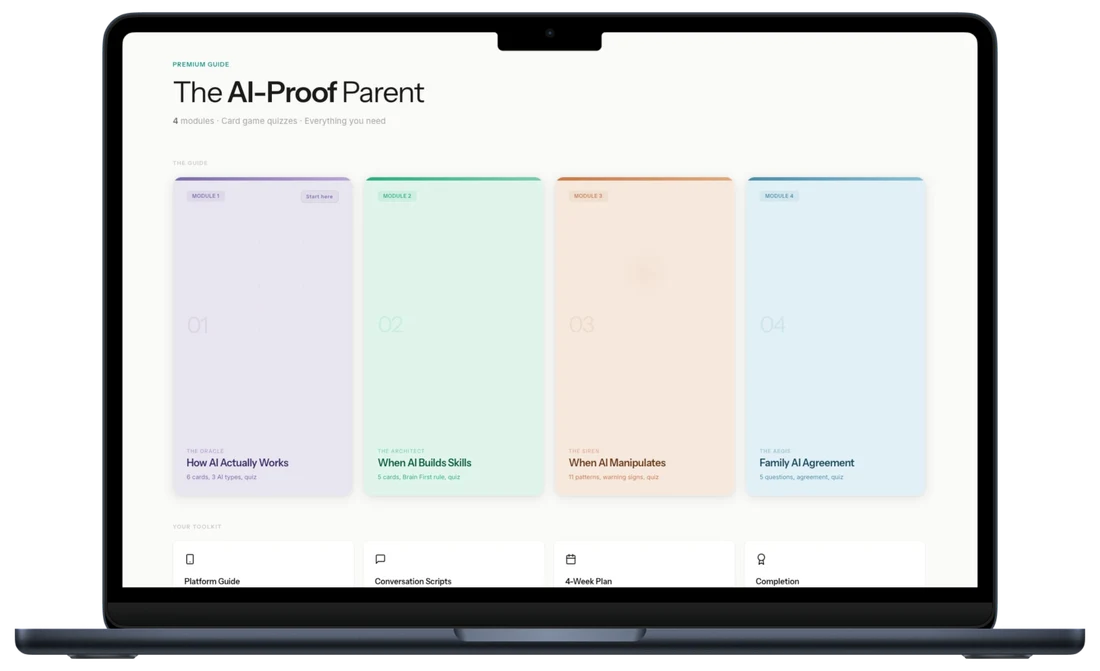
Most children are already using ChatGPT, Character AI, or Meta AI — and most parents have no idea what they are saying. This guide gives you the framework to understand, set boundaries, and have the conversations that matter.
Want personalised help instead?
The guide gives you the system. A session gives you a plan built around your child, your family, and your specific situation. One call. 45 minutes. Everything changes.
Your TikTok Questions Answered