Your Child Won't Stop Gaming. Limits Aren't
Working. Here's What I Tell Every Parent.
The gaming arguments keep happening. Whatever you've tried hasn't stuck for more than a few days — and you're starting to wonder if something is genuinely wrong, or if you're just not handling this right.
daily screen time arguments
The evening screen time battle isn't about your child being defiant. Modern screens — whether it's Fortnite, TikTok, YouTube, or AI chatbots — are optimised to resist interruption. Screen time coach Daniel Towle explains: "Your child isn't ignoring you. They're mid-dopamine hit, mid-conversation, mid-achievement. Asking them to stop is like asking someone to walk out of a cinema during the climax."
You have probably seen this pattern
You do not need to check every box. One is enough to know this matters.
Screen Time Battles Aren't a Discipline Problem. They're a Product Problem.
Why Every Evening Ends the Same Way
The evening screen time battle isn't about your child being defiant. Modern screens — whether it's Fortnite, TikTok, YouTube, or AI chatbots — are optimised to resist interruption. Screen time coach Daniel Towle explains: "Your child isn't ignoring you. They're mid-dopamine hit, mid-conversation, mid-achievement. Asking them to stop is like asking someone to walk out of a cinema during the climax."
Here's what's happening in their brain. Screens deliver fast, unpredictable rewards — a new TikTok, a kill in Fortnite, a reply from a friend, a surprising answer from ChatGPT. Each one releases a small dopamine spike. Not because screens are evil, but because that's how variable reward systems work. Slot machines use the same principle.
When you say "time's up," you're not just ending an activity. You're asking their brain to go from high stimulation to low stimulation — immediately. That transition is genuinely uncomfortable. For younger children whose prefrontal cortex is still developing, it's even harder. They're not choosing to be difficult. They physically struggle with the switch.
And here's the bit most parents miss: evening is when impulse control is at its weakest. Your child has used up their self-regulation all day at school. By 6pm, asking them to make a rational decision about putting the screen down is like asking someone who's been dieting all day to walk past a cake. The willpower tank is empty.
What Your Child Actually Experiences When You Say "Time's Up"
Understanding your child's perspective doesn't mean giving in. It means knowing why the reaction is so intense — so you can respond to the actual problem, not just the behaviour you see on the surface.
They're About to Finish Something
Games and apps are specifically built without natural stopping points. A Fortnite match takes 20 minutes. A TikTok feed never ends. A Roblox build has no save point. There is always one more thing about to happen — and the product is optimised for that.
They're Losing Their Only "Win" of the Day
For some children — especially those who struggle at school or socially — screens are the one place where they feel competent and in control. Taking it away doesn't just end fun. It ends the only activity where they felt good at something that day.
The Transition Hurts
Going from a high-dopamine activity to homework, bath time, or bed is a neurological cliff edge. It's not comfortable. For children with ADHD or autism, this transition can be physically painful. The meltdown isn't defiance — it's genuine distress at the abrupt change.
Three Things That Guarantee a Worse Evening
Daniel Towle has identified three patterns that turn a normal evening into a battleground. Most families are doing at least one of these without realising it.
Negotiating the Rules Every Single Day
If the "how long can I have?" conversation happens every evening, you've accidentally made screen time the central topic of your relationship with your child. Every negotiation reinforces the same message: screens are the most important thing in the house, because it's all anyone talks about. The pattern needs to change — but the alternative isn't what most parents expect.
Pulling the Plug Mid-Session
Walking over and turning off the TV, the console, or the phone without warning guarantees the maximum emotional reaction. You've interrupted a dopamine loop, ended a social interaction with real people, and removed all sense of control — simultaneously. The neurological response is genuine distress, not defiance. There's a way to handle transitions that works with the game's structure rather than against it — and it's different for every game.
Using Screens as the Reward and the Punishment
"If you behave, you can have extra screen time." "If you don't listen, I'm taking the iPad away." Both of these make screens the most powerful currency in your household. You've told your child — without meaning to — that screens are the most valuable thing you can give or take away. The families who break this cycle don't just find better rules. They find a completely different framework for how screens fit into the household.
What the Families Who Stopped Fighting Did Differently
Screen time coach Daniel Towle, who spent 8 years as Head of Technology in London schools, has found that the families who stopped having evening battles didn't get stricter. They got smarter. And the shift was never about finding the right app or the right parental control setting.
The pattern is consistent: the ones who break through are the ones who stop treating screen time as the enemy and start understanding the specific product their child is using. A child on Fortnite is in a completely different situation from a child scrolling TikTok or talking to an AI chatbot. The pull is different. The psychology is different. And the approach has to be different.
The families who stopped having evening battles didn't find a stricter rule. They found a way to help their child understand why the screen was so hard to put down. Once a child sees how the product is designed to resist interruption, the transition stops being a fight — because they finally get why it's hard.
— Daniel Towle, Digital Family CoachMost families come to me after trying the obvious things — timers, confiscation, shouting, giving in. None of those address why the battle happens in the first place. Once you understand the mechanics behind the screen (and they're not complicated, they're just hidden), the conversation changes completely. You stop fighting the symptom and start addressing the cause.
Here's what gives me hope: In my experience, most families see the evening dynamic change within two weeks. Not because the child suddenly develops perfect self-regulation — but because the parent finally understands what they're up against. Once you see the mechanics, you can't unsee them — and neither can your child.
When Evening Battles Are a Sign of Something Bigger
Most evening screen time arguments are normal. But Daniel Towle, who has supported over 1,000 families, says some patterns indicate the problem has moved beyond typical evening friction. The NHS Every Mind Matters resource can help you assess where your family sits.
I Know What the Pull Feels Like
I ran a gaming channel. I made friends online who I don't really have anymore — because we don't play those games anymore. I know what it's like to get caught up in a game's world, especially when your brain is wired for it. I'm currently waiting for my own ADHD diagnosis, and understanding why these products fulfil what they fulfil has been a big part of my own journey.
When your child melts down because you said "time's up," they're not showing you who they are. They're showing you what the product does to them. Understanding the pull — not punishment — is what changes the dynamic.
— Daniel Towle, Digital Family CoachThen I tried creating parenting content on TikTok. Within weeks, I was scrolling instead of creating. Same pull. Different product. That's when I understood: this isn't about willpower. It's about products optimised to override it. I spent 8 years as Head of Technology in London schools — including settings for children with ADHD and autism — watching these same patterns repeat in hundreds of children.
More from the Screen Time Series
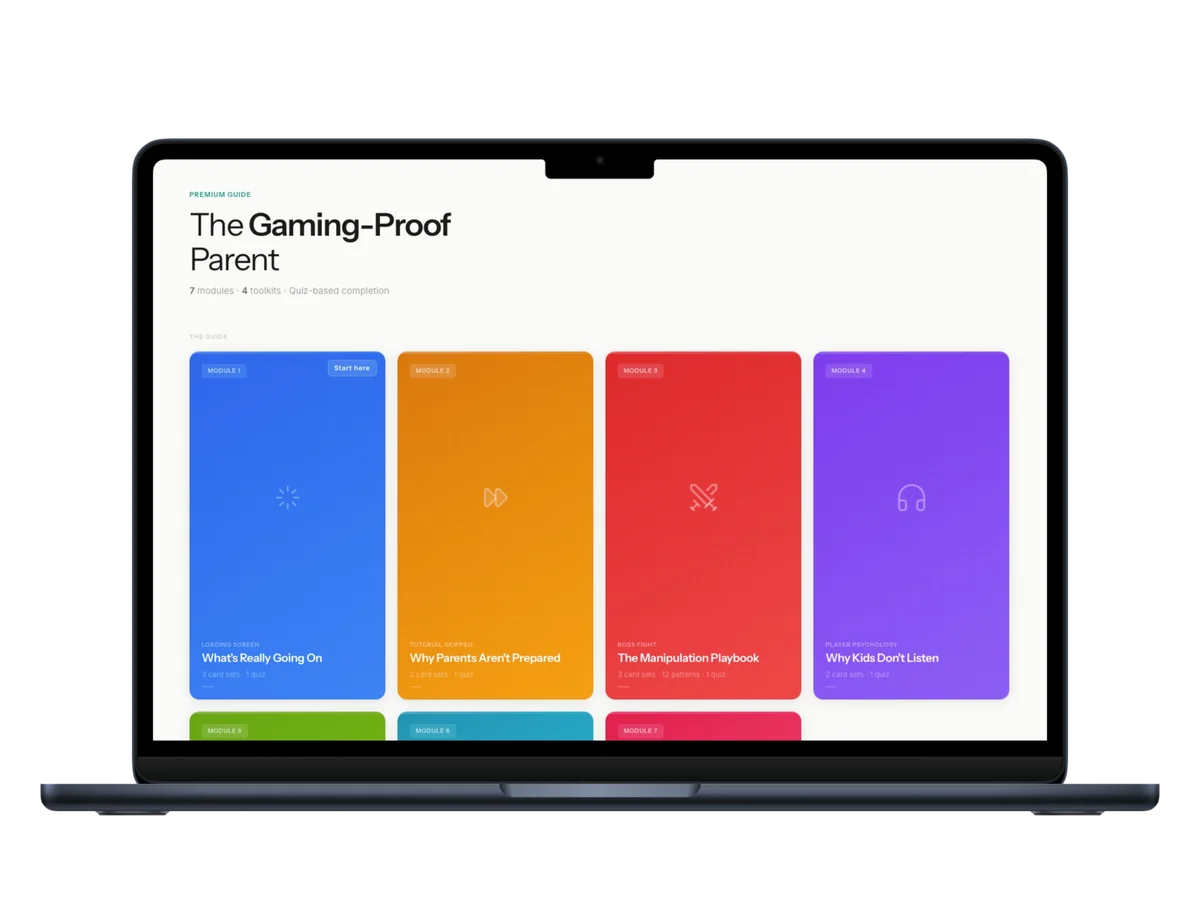
Every game your child plays is engineered to make stopping feel impossible. This guide breaks down exactly how — and gives you the conversations, the boundaries, and the 4-week plan to change it.
Want personalised help instead?
The guide gives you the system. A session gives you a plan built around your child, your family, and your specific situation. One call. 45 minutes. Everything changes.
Your Questions Answered