My Child Will Not
Stop Gaming
You have tried limits, bans, rewards, and consequences. Nothing sticks. The problem is not willpower -- it is how games are engineered to override it.
time for UK children
You have probably seen this before
You do not need to check every box. One is enough to know this page is for you.
Why Your Child Can't Stop Gaming
Your child isn't the problem. Every game they play — Fortnite, Roblox, FIFA — uses the exact same psychological toolkit. And that toolkit was built by people who are very, very good at what they do.
Based on primary research with children aged 9–11
Every popular game — Fortnite, Minecraft, Roblox, FIFA — uses the same psychological toolkit. Daily rewards punish you for missing a day. Battle passes create a sunk-cost loop ("I've paid for it, I have to complete it"). Time-limited events generate artificial urgency. And social features mean walking away from the game means walking away from your friend group.
For children, these systems are especially powerful. Their prefrontal cortex — the part of the brain that handles impulse control — won't fully develop until their mid-twenties. Asking them to self-regulate against systems optimised by professional psychologists is like asking them to out-negotiate a team of lawyers. The game isn't a fair fight.
Three Things That Make Gaming Problems Worse
There are three patterns that make gaming problems worse. Most parents try all three before they land here — and each one escalates the conflict without addressing the underlying issue.
Removing the Game Cold Turkey
It feels like the obvious solution. But for a child whose social life, identity, and emotional regulation are built around gaming, removing the game without a replacement is like taking away someone's coping mechanism without offering an alternative. The meltdown isn't defiance — it's genuine distress.
Negotiating Screen Time Limits Daily
If you're having the "how long can I play?" conversation every single day, you've turned screen time into the main topic of your relationship. The child learns that gaming is the most important thing in the house — because it's all anyone talks about. The negotiation IS the problem.
Blaming the Child Instead of Understanding the Product
Phrases like "you have no self-control" or "what's wrong with you?" make the child feel broken. They're not broken. They're using a product that spent millions of pounds in development to keep them engaged. The problem isn't your child's character — it's the environment you're both navigating.
Sound familiar? Most parents have tried at least two of these before they land here. None of them work because they all treat the symptom — the gaming — rather than what's driving it. Parental controls handle about 5% of the solution. The other 95% is understanding and conversation.
— Daniel Towle, Screen Time CoachIs My Child Addicted to Gaming?
When parents ask me this, I tell them to forget the hours. There's one thing to watch for that tells you more than any screen time tracker — and most parents have never thought to look for it. The distinction between a gaming hobby and a genuine problem isn't where you'd expect.
The World Health Organization recognised gaming disorder in 2019 — but that clinical threshold is deliberately high. Most children who are struggling with gaming won't meet it. That doesn't mean there isn't a problem.
A more useful test: look at what happens when the game is unavailable. The reaction tells you more than the hours ever will. A child who shrugs and finds something else to do is in a different place from a child who spirals into anger, anxiety, or complete shutdown. One is gaming as a hobby. The other is gaming as a coping mechanism — and the distinction matters.
The other question worth asking: is gaming one of many things in their life, or the only thing? A child with friendships, activities, and interests outside gaming who also plays for two hours a day is not the same as a child whose entire social world, identity, and emotional regulation is built around one game.
What Actually Helps When Your Child Won't Stop Gaming?
The families who break through this aren't the ones with the strictest rules — and the shift happens faster than most parents expect. What changes isn't the rules themselves. It's something most parents have never been shown about how their child's specific game actually works on them.
The families who make the shift start by asking different questions. Not "how do I get them off the game?" but "what is this game giving my child that they're not getting anywhere else?" In every session, I'm looking at the same things: what are they escaping from? What need is the game meeting — social connection, achievement, control, escape? How is the game's progression system keeping them hooked? And the question most parents have never considered: where does that energy go when you take the game away? Because if you don't have an answer to that, neither does your child.
The shift isn't about control — it's about understanding. The families who break through this have one thing in common: they learn how specific games are engineered to keep children playing, and they use that knowledge to have conversations that genuinely shift how their child sees the product. Not lectures. Not ultimatums. Conversations that change the dynamic because the parent finally understands what they're dealing with.
That understanding changes everything — how you set rules, how you talk about gaming, and how your child responds when you do. The American Academy of Pediatrics recommends a similar family-centred approach: structure built around understanding, not restriction alone.
What Every Parent Needs to Understand First
- Your child isn't broken — the product is engineered to behave exactly the way it does
- Parental controls are necessary but only address a fraction of the problem
- The goal isn't zero gaming — it's a child who can regulate their own relationship with it
- There are specific reasons your child can't stop — and they're built into the game on purpose
Here's what gives me hope: Most families see meaningful change within weeks — not months. The shift usually happens when parents stop fighting the game and start understanding it. Once you see the mechanics, you can't unsee them, and neither can your child.
When I Knew This Was More Than a Job
I've been teaching technology in schools for 12 years. But it's really in the last four to five years that I've noticed something profound — a massive gap between what children are actually doing online and what their parents understand about it.
I've been watching this develop for over a decade — the games getting more engineered, the social pressure intensifying, the parents getting more confused and more exhausted. I know exactly where the problems stem from because I've seen them emerge in real time, working in schools every single day — including settings for children with ADHD and autism. If I can do this for parents in a school, I can do it for your family too.
The main issue — and why there's no silver bullet — is that each family is different. You get to decide how you parent. You get to decide what goes on in your house. But when you're not given the correct information, it's very hard to make the right choice. That's exactly what I help parents do.
I've spent 12 years watching this problem get worse. I know where it stems from. And I know that when parents are given the right information, they make the right choices. Again and again.
— Daniel Towle, Screen Time CoachWhen Should You Get Professional Help for Gaming?
After 12 years working with families, I've learned to look for one thing: not the hours, and not the game. It's what happens when the game is taken away. If you've tried multiple approaches and nothing holds for more than a week, that's not a parenting failure — it's a signal the usual approaches aren't enough for what you're dealing with.
The NHS Every Mind Matters resource can help you assess the situation. Not every child who games a lot has a problem. The question isn't hours — it's impact. A child who plays two hours a day, sleeps well, does their homework, and has friends outside gaming is in a very different place from a child who plays two hours a day but melts down if they can't play, has no other interests, and lies about their gaming time.
- Stealing money or payment details for in-game purchases
- Aggressive or violent outbursts when gaming is interrupted
- Consistently skipping meals, homework, or sleep to play
- Complete withdrawal from all non-gaming activities and friendships
- Your child has expressed distress about their own inability to stop
- You've tried setting limits multiple times and they never hold
- Gaming is causing daily arguments in your household
- Your child's mood is entirely dependent on whether they can play
- School performance has noticeably declined
- Your partner and you consistently disagree about how to handle it
- Notice whether the anger is specific to one game or happens with all screens
- Pay attention to what your child talks about when they're not gaming — that tells you what the game is replacing
- Ask yourself: is gaming one of many things in their life, or the only thing?
More from the Gaming Series
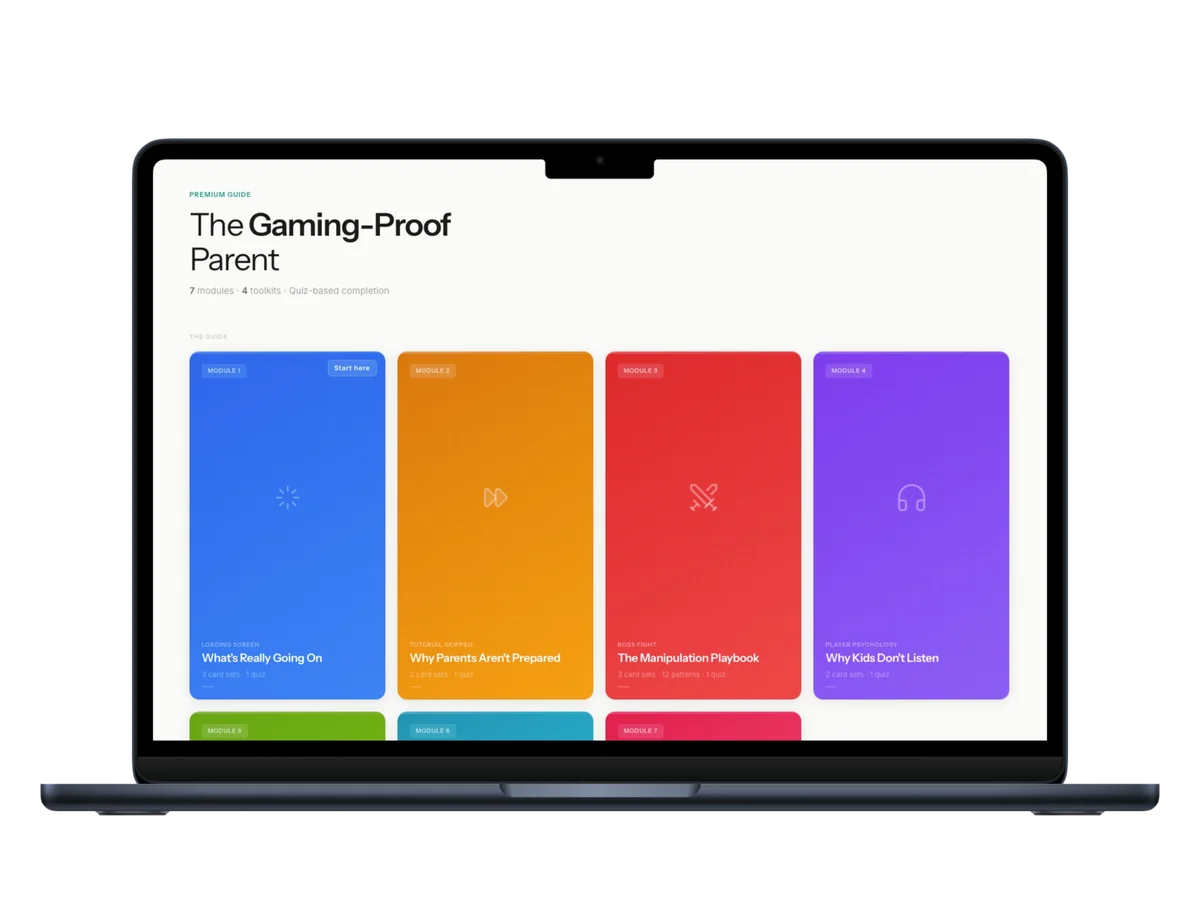
Every game your child plays is engineered to make stopping feel impossible. This guide breaks down exactly how — and gives you the conversations, the boundaries, and the 4-week plan to change it.
Want personalised help instead?
The guide gives you the system. A session gives you a plan built around your child, your family, and your specific situation. One call. 45 minutes. Everything changes.
Questions Parents Ask About Gaming
Sources & Further Reading
- World Health Organization — Gaming Disorder (ICD-11, 6C51)
- American Academy of Pediatrics — Media and Children
- NHS Every Mind Matters — Is My Child Spending Too Much Time Online?
- The Washington Post — Kids, Parents & Tech Help (November 2025)