What Age Should a Child Have an iPad?
(You Are Asking the Wrong Question)
What age should kids get an iPad? You have probably already worked out that the answer does not come from a chart. You bought it for travel. A long car journey, a flight, maybe just to survive a rainy half-term. It worked straight out of the box — no setup, no fuss. They loved it. And somewhere between downloading YouTube and handing it over at bedtime, the iPad went from “something for the journey” to the centre of every argument in your house.
use a tablet at home
The iPad is usually a child's first device. It arrives for a completely reasonable reason — and what happens next follows the same pattern in almost every family. Daniel Towle, a screen time coach who has worked with over 1,000 families, sees the same story play out every time.
You have probably seen this pattern
You do not need to check every box. One is enough to know this matters.
Short Term Gain. Long Term Pain.
When Should Kids Get an iPad?
The iPad is usually a child's first device. It arrives for a completely reasonable reason — and what happens next follows the same pattern in almost every family. Daniel Towle, a screen time coach who has worked with over 1,000 families, sees the same story play out every time.
Travel is the number one reason. Parents need something their child can watch content on during a long journey. Why the iPad? Because it works straight out of the box. You buy it and it is there. No major fuss. That simplicity is exactly what makes it the default choice — and exactly why the problems start so quickly.
If you are buying an iPad for travel, stick to the reason you are buying it. One app. Download the films beforehand. The problems start when the reason changes — and it always changes, because nobody plans what happens after the journey ends.
— Daniel Towle, Screen Time CoachAfter travel, it is Christmas, a birthday, or a hand-me-down. A family member is not using theirs anymore and the child asks, “Can I have it?” Then the self-talk starts: “It would just be wasting it. They could use it just for that. It is old anyway.” None of this is related to what is actually going to happen next.
It Always Goes Wrong. Not Sometimes. Always.
After 8 years as Head of Technology in London primary schools and working with over 1,000 families, Daniel Towle has watched this pattern play out enough times to say it with certainty: without the right setup and roadmap, it always goes wrong. The only variable is how long it takes.
It starts with YouTube. Parents think of it as a portable television — their child can watch their favourite videos, and that is that. YouTube is not a portable television. It is a platform where your child can see every single person's comments, which link to other videos, which link to other content, other channels, and other ways of thinking. Children should not be exposed at such a young age to the thoughts of everybody on the internet.
And that is before you get to the content itself. The sheer amount of clickbait. The jump cuts optimised to hold a developing attention span. Influencers and creators have worked out exactly how to keep your child watching — because that is how they make their money. Everything is bright, bold, quick, and intriguing. YouTube and other platforms prioritise content based on how well it performs, not whether it is appropriate for your child. The algorithm does not care that they are six.
Then the iPad moves. It starts in the living room. Then it is in the kitchen while you cook. Then it is in the car for every journey, not just the long ones. Then it goes to the bedroom. Each step felt reasonable at the time. None of them were planned. And by the time you notice, the iPad is no longer a travel device — it is the first thing they reach for in the morning and the last thing they put down at night.
I have watched this happen with many of my friends' children. As soon as the iPad was bought, it was simply a matter of time — a few months — before it went from something to watch downstairs to something the children would take to their bedroom. They were always watching YouTube Shorts. I asked them: “What do you watch on there?” They said: “I do not really know. I just scroll until I find a video I like.”
That says everything. The child is not aware of what they are doing or why they are doing it. And that is the moment most parents start searching for articles like this one.
YouTube Is Not a Portable TV
Daniel Towle is unequivocal on this: YouTube and YouTube Shorts are the most significant risk for children under the age of twelve on any device. And the iPad is where most children first encounter them.
When a parent hands over an iPad with YouTube, they are picturing something like CBeebies on demand. What they are actually giving their child is an algorithmically driven platform with no natural stopping point, a comments section full of adults, autoplay that serves content based on engagement rather than age-appropriateness, and recommendations that get progressively more extreme the longer a child watches.
If I had a child, there is no way I would give them an iPad. Ever. And there is no way I would allow them near YouTube without very strict boundaries and teaching them how to use it and what to use it for. Want to know why? That is exactly what I cover in a session.
— Daniel Towle, Screen Time CoachYouTube Kids exists, but something being less terrible than the main platform does not make it safe. The algorithm still decides what comes next. There is still no natural stopping point. And children outgrow it quickly — or figure out how to switch to the main YouTube app, which is a completely different environment. Do not let the word “Kids” in the name give you false confidence.
Research published by CNN in 2024 found a direct link between early tablet use and increased anger outbursts — with children who used tablets at age 3.5 showing significantly higher frustration at age 4.5. The relationship was bidirectional: more frustrated children also used tablets more, creating a cycle that is difficult to break without understanding what is driving it.
“It Is Educational” — Short Term Gain, Long Term Pain
Screen time coach Daniel Towle hears the same justifications in nearly every family he works with. They are not wrong, exactly. They are just incomplete — and the gap between the justification and what actually happens is where the problems grow.
“It Is Educational”
Some of it genuinely is. But parents do not know what educational content actually looks like — and more importantly, they do not know how to find educational content that their child actually wants to engage with. There is a difference between an app that teaches and an app that entertains while looking like it teaches. Most parents cannot tell the difference, and neither can their children.
“They Only Watch This”
Right now, maybe. But every app leads somewhere. YouTube leads to Shorts. Shorts lead to comments. Comments lead to links. One reasonable download creates the conditions for the next. What your child watches today and what they are watching in three months are rarely the same thing — and they will not tell you it has changed, because they think you will take the iPad away.
“It Keeps Them Quiet So I Can Cook Dinner”
This is the most honest one. And Daniel Towle does not judge parents for it. But it is the definition of short term gain over long term pain. Twenty minutes of quiet now can create twenty minutes of meltdown later — every single time the iPad is taken away. The trade-off compounds.
What I Saw Teaching with iPads for 12 Years
Daniel Towle spent 8 years as Head of Technology in London primary schools. In the last three years, most of his time was taken up with iPad questions. Not because iPads were useful — but because they were creating problems nobody had anticipated.
Schools were buying iPads to look technologically advanced to the parents who sent their children there — without actually thinking about what the iPad was being used for. I watched enormous amounts of lesson time wasted on iPads being used for “research,” which in practice meant a child going online to find a single picture related to the topic they were studying. That was it — that was what was classed as research. When you look underneath the surface and start asking what children are actually doing on iPads, the answer is usually: not that much.
I taught over 1,000 children every day without iPads causing issues or drama. Not because I had stricter rules, but because the environment was set up before anyone walked through the door. That is the same approach I take with families.
— Daniel Towle, Screen Time CoachTeachers used iPads to manage behaviour in classrooms. It kept children quiet. It gave them something to do. I was never comfortable with this, and my own lessons would always avoid iPads as much as possible. In fact, I dreaded covering an iPad lesson — because I could see what was actually happening beneath the surface.
Parents would see their children using an iPad and think: “They are really good with technology.” What I saw was something different. What looks like collaboration is often something else entirely. What looks like engagement is often passive consumption. And what looks like learning is often just screen time with an educational label on it.
What I found in those 12 years — the patterns, the behaviours, the things that actually worked and the things that made everything worse — is what I share in my sessions. I had to fight the iPad constantly. And in that fight, I learned things about how children actually use these devices that most parents and most teachers never see.
I Do Not Judge Parents for This. Here Is Why.
Taking children on residential trips — being with them for five solid days — and spending time with friends who have children and teenagers genuinely opened my eyes. As teachers, we have a habit of thinking we know what is best because we see a side of children that parents do not always see. “He is not like that at home,” parents would tell me. “He is always shouting and arguing.” I used to wonder why. Now I understand.
I want parents to come home and know that when their child is on a device, they are doing something that helps them progress and gives them an edge in the real world. That is what a session sets up.
— Daniel Towle, Screen Time CoachLooking after children on a day-to-day basis is genuinely exhausting. Parents are not getting their own free time. They cannot switch off. So the idea of having something their child can use — something they know is safe — is not laziness. It is survival.
Unfortunately, I see the same pattern all across the world: parents getting caught in a loop of thinking the device is safe, when the reality is that it is not — not without the right setup. What I do is help parents achieve what they are actually looking for: beneficial content, tasks, and projects that use technology to supercharge their child’s ability to learn, without taking away their progression.
The issue is that parents do not know what that setup looks like. They do not know what genuinely educational content looks like, or how to find content their children actually want to engage with. I had children in my classes asking if they could do tasks as homework — can you imagine that? Children actively wanting to do homework. Why? Because the projects were relatable. They wanted to learn and they wanted to create. That is not about the device. It is about what is on it.
More from the Screen Time Series
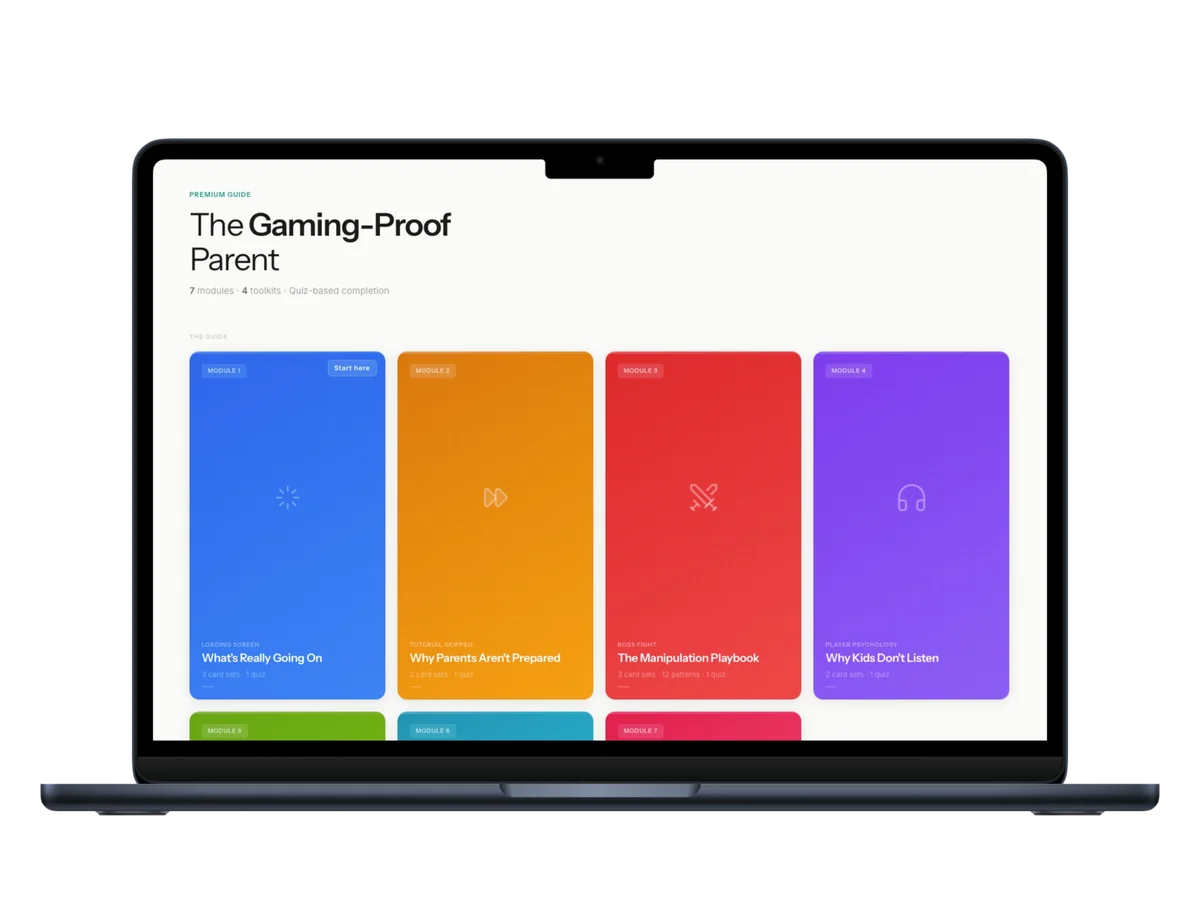
Every game your child plays is engineered to make stopping feel impossible. This guide breaks down exactly how — and gives you the conversations, the boundaries, and the 4-week plan to change it.
Want personalised help instead?
The guide gives you the system. A session gives you a plan built around your child, your family, and your specific situation. One call. 45 minutes. Everything changes.
Your Questions Answered