How Much Screen Time Is Too Much?
(It's the Wrong Question)
You've Googled the recommended screen time. You've read the articles that say two hours. You've tried timer apps, screen time trackers, and counting minutes on a whiteboard. Some of it felt right for a while — but then homework happened on the laptop, and suddenly you're at four hours before they've even touched a game. Meanwhile, some screen time seems perfectly fine and some clearly isn't.
that does not work
The 2-hour guideline treats all screen time as equal. FaceTiming grandparents is not the same as infinite-scrolling TikTok. Building in Minecraft is not the same as watching unboxing videos. Time is the wrong metric — the question is what the screen is doing to your child's behaviour, mood, and relationships.
You have probably seen this pattern
You do not need to check every box. One is enough to know this matters.
Screen Time Isn't a Numbers Problem. It's a Product Problem.
Why the "2 Hours" Rule Doesn't Work
The 2-hour guideline treats all screen time as equal. FaceTiming grandparents is not the same as infinite-scrolling TikTok. Building in Minecraft is not the same as watching unboxing videos. Time is the wrong metric - the question is what the screen is doing to your child's behaviour, mood, and relationships.
The "2 hours a day" figure most parents have heard originally came from the American Academy of Pediatrics in 1999. It was created for a world of television - before smartphones, before social media, before games that never end. The AAP itself moved away from rigid time limits in 2016, replacing them with a "family media plan" approach. But the two-hour number stuck in the public imagination like a fact carved in stone.
The Royal College of Paediatrics and Child Health in the UK looked at the evidence in 2019 and concluded there wasn't enough to set a specific time limit. Their advice? Focus on whether screen time is displacing other important activities - sleep, exercise, homework, face-to-face socialising. That's a fundamentally different question from "how many minutes."
The reason the number never felt right to you is because it isn't right. A child spending two hours coding a website is having a completely different neurological experience from a child spending two hours on an infinite-scroll feed. Treating them the same doesn't just miss the point - it actively creates the wrong fights in your household.
If your house is stuck on the time-only question, that's exactly the question I unpack with families as a private screen time consultant - looking at what your child is actually doing on the screen, what it's doing to them, and how the family responds when limits hit.
Not All Screen Time Is Equal
Screen time coach Daniel Towle, who spent 8 years as Head of Technology in London schools, puts it simply: "The question isn't how long they're on a screen. It's what the screen is doing to them while they're on it. Those are two completely different conversations."
Here's the distinction that changes everything. Active screen time involves creating, communicating, or problem-solving — building in Minecraft, video-calling a friend, learning to edit a video, researching a school project. Passive screen time involves consuming content chosen by an algorithm — scrolling TikTok, watching autoplay YouTube, swiping through Instagram Reels. The neurological effects are genuinely different.
I tell every parent the same thing: stop counting minutes. Start watching what happens when the screen goes off. That single observation tells you more about your child's screen time than any timer app ever will.
— Daniel Towle, Screen Time CoachActive use tends to be self-directed. Your child chooses what to build, who to talk to, what to create. There's a goal and often a natural stopping point. Passive use is algorithm-directed. The platform decides what comes next. There's no natural stopping point because the feed is literally infinite. That's why three hours of Minecraft and three hours of TikTok produce completely different children at the end of it.
Nobody ever panicked about their child reading for three hours. But three hours on a screen? That's a crisis. The difference isn't the time. It's the activity. And until parents can reliably tell the difference between what their child is actually doing on a screen — or notice when one type slides into another — the "how long" question will keep producing the wrong answers.
The Three Questions That Matter More Than Minutes
Daniel Towle uses the same three questions in every coaching session. They don't require any apps, any timers, or any arguments. They just require you to notice what's already happening in your household.
What Happens When the Screen Goes Off?
This is the single most telling indicator. If the transition is relatively smooth — some grumbling, but they move on within a few minutes — that's a good sign. If it triggers a meltdown every single time, regardless of how long they've been on, that tells you something important about the relationship between your child and that particular screen activity. The reaction to stopping is more diagnostic than the amount of time spent.
What Is the Screen Displacing?
Are they still seeing friends in person? Still sleeping well? Still doing schoolwork without it becoming a daily battle? Still interested in at least one or two non-screen activities? If the answer to most of those is yes, the screen time is probably fitting into a balanced life. If the screen has quietly replaced all of it — and you only notice when you look back over the last few months — that's a different situation entirely.
Is the Screen Time Active or Passive?
Are they creating, communicating, learning, or building something? Or are they consuming, scrolling, and watching whatever the algorithm serves up next? Most children do both — the question is the ratio, and whether they can tell the difference themselves. A child who can articulate what they're doing and why is in a fundamentally different place from a child who can't explain what they've been watching for the last two hours.
When Screen Time Becomes a Problem
There's a difference between screen time that's part of a normal childhood and screen time that has started to change your child's behaviour, mood, or relationships. Screen time coach Daniel Towle, who has supported over 1,000 families, says the line isn't about hours — it's about impact.
I Stopped Counting Minutes Years Ago
Early in my career as Head of Technology in London schools, I used to give parents the same advice everyone else did: set a time limit, stick to it, be consistent. It sounded sensible. It almost never worked. Parents would come back a month later with the same problems — or worse ones, because the time limit had become the new battleground.
Once I stopped asking "how long" and started asking "what's happening," the families I worked with stopped fighting about minutes and started understanding what was actually going on. That shift changes everything.
— Daniel Towle, Screen Time CoachThe shift happened when I started asking different questions. Instead of "how long are they on screens?", I asked "what happens when the screen goes off?" Instead of "how many hours?", I asked "what's the screen replacing?" The answers told me everything the timer never could. A child spending an hour on Roblox building a world with friends was in a completely different place from a child spending an hour passively scrolling YouTube Shorts. Same screen. Same time. Completely different impact.
I felt this myself. I got pulled into TikTok as an adult — I went on to create parenting content and ended up scrolling instead of creating. The time wasn't the problem. The product was. And that's the distinction most screen time advice completely misses.
More from the Screen Time Series
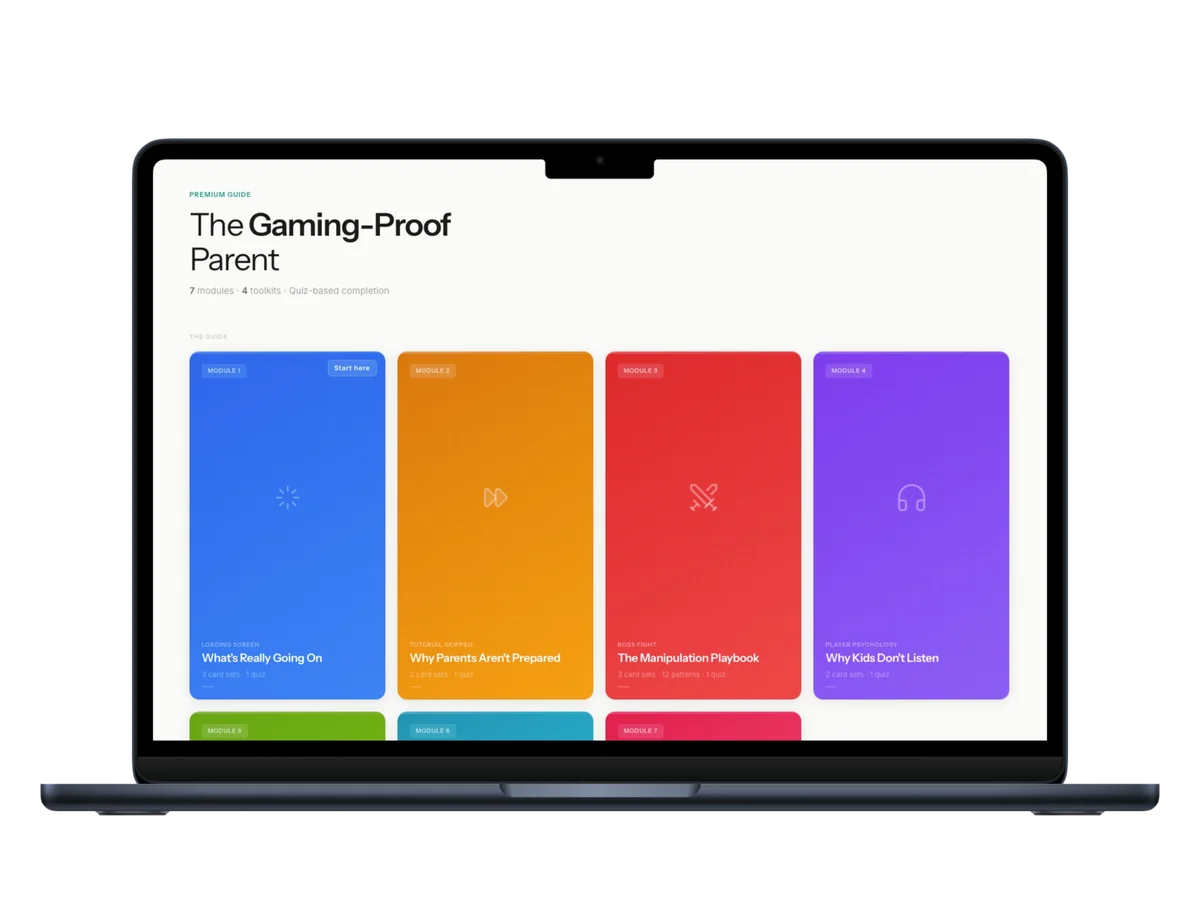
Every game your child plays is engineered to make stopping feel impossible. This guide breaks down exactly how — and gives you the conversations, the boundaries, and the 4-week plan to change it.
Want personalised help instead?
The guide gives you the system. A session gives you a plan built around your child, your family, and your specific situation. One call. 45 minutes. Everything changes.
Your Questions Answered