When Should I Give My Child a Phone?
(It's Not About Age)
You've been having this conversation for months. Other parents are buying phones. The school says they need one for a group chat. Grandparents have already offered to get one for Christmas. You're trying to make the right call — but there's no clear guidance, and every family seems to be doing something different.
get their first phone
The question isn't "what age should I give my child a phone?" It's "what phone, what rules, what access, and is your child ready to navigate what comes with it?" Screen time coach Daniel Towle explains why readiness — not a number on a birthday cake — is what actually matters.
You have probably seen this pattern
You do not need to check every box. One is enough to know this matters.
The First Phone Isn't a Gift. It's an Environment Change.
Why Age Is the Wrong Question
The question isn't "what age should I give my child a phone?" It's "what phone, what rules, what access, and is your child ready to navigate what comes with it?" Screen time coach Daniel Towle explains why readiness — not a number on a birthday cake — is what actually matters.
According to Ofcom's latest research, 91% of children have a smartphone by age 11. So the question of whether to give them one has, for most families, already been answered by everyone around them. The real question is how.
Here's what most parents miss: a 10-year-old with a locked-down phone and clear rules from day one is in a better position than a 13-year-old with unrestricted access and no structure. Age is a red herring. Readiness is everything. And readiness isn't something you can Google — it depends on your specific child, their specific habits, and the environment you set up before the device arrives.
The phone you buy for emergencies — so they can text you when they get to school, so you know they're safe on the bus — has a strange tendency to become a portal to everything you were trying to delay. That's not your fault. It's how the ecosystem works. One reasonable decision leads to the next, and before you know it, the "safety phone" has TikTok, Instagram, and a group chat you didn't know about.
What Most Parents Get Wrong About the First Phone
After working with over 1,000 families, Daniel Towle has identified four patterns that consistently lead to first phone problems. Most families fall into at least one — and none of them are about choosing the wrong device.
Buying the Phone Without Setting Up the Rules First
The device arrives, excitement takes over, and rules come later. By then the precedent is set. Your child has already explored, downloaded, and formed habits — and every rule you introduce after that point feels like something being taken away, rather than something that was always part of the deal.
Treating All Screen Time as Equal
Messaging friends about homework is not the same as infinite-scrolling TikTok at midnight. But the phone gives access to both. Most parents set a single "screen time" rule when the reality is that different activities have completely different effects — and the phone doesn't distinguish between them.
Assuming Parental Controls Do the Job
Controls manage access. They don't teach judgement. A child who has never encountered a dodgy link, a manipulative message, or a social media algorithm isn't safer because they've been shielded from all of them — they're just less prepared for the moment the controls come off. And they always come off eventually.
Giving Full Access and Trying to Restrict Later
Starting open and pulling back is dramatically harder than starting restricted and earning access. Every restriction feels like a punishment. Every conversation becomes a negotiation. The families who get this right do it the other way around — and the child understands why from the start.
The Slippery Slope Every Family Slides Down
The first phone rarely stays the way you intended it. Daniel Towle describes the pattern he's watched play out in hundreds of families — and every step along the way felt perfectly reasonable at the time.
It starts with a phone for safety. They need it for the bus, for after-school clubs, for letting you know they've arrived. Fair enough. Then they need it for travel, so one game is fine — keeps them quiet on the train. Then they need WhatsApp because the school uses a class group chat. Then TikTok goes on "because everyone has it" and they're being left out of conversations. Then the phone is in the bedroom because that's where they do homework.
The problem isn't any single decision. It's that each small, reasonable step creates the conditions for the next one. By the time families come to me, they're not dealing with a phone problem — they're dealing with an environment that shifted without anyone noticing.
— Daniel Towle, Digital Family CoachEach step felt reasonable. None of them were planned. And by the time you realise the phone has become the centre of their world, you're several steps past the point where the conversation should have happened. This isn't a parenting failure — it's how the ecosystem is built. Each app, each platform, each feature is optimised to become the next thing on the phone. One small change gets counteracted by everything else.
How Do You Know If Your Child Is Ready?
There's no test. No checklist that guarantees you're making the right call. But after 12 years watching first phones arrive in schools, Daniel Towle has noticed clear patterns in what separates the transitions that go well from those that don't.
I See the Same Pattern in Every Family
After 8 years as Head of Technology in London primary schools and working with over 1,000 families, I see the same story play out no matter how parents phrase it to themselves or their own children. It always starts the same way: rules are set, everyone agrees, and for the first few days it works. Then real life kicks in.
The phone is not the problem. The environment is the problem. And most families do not get help with the environment until things have already gone wrong.
— Daniel Towle, Digital Family CoachParents are human. Being asked constantly, day after day, wears you down. Your child asks for an app because their friends have it — usually at a moment when you are in the middle of something stressful — and it ends with, "well, OK, let's see how it goes." That is not weakness. That is being a normal parent under normal pressure, facing a child who will not stop asking.
But the pressure does not just come from your child. There are influencers and content creators online directly targeting children, encouraging them to use apps they would not normally ask for and teaching them how to get around parental controls. Children want Telegram because their favourite creator has a "private" channel with exclusive content. They want apps you have never heard of because someone at school showed them. The peer pressure on children and teenagers is immense — and it gets passed straight on to parents. "It's not fair." "I'm only using it for this." "Everyone else has it."
That might be true in that moment. But three weeks later, that app has led them somewhere else entirely — and they do not want you to know, because they think you will take the phone away. My research shows this pattern consistently. It is always the same story.
A session with me sets you up the right way — the same way I was able to teach over 1,000 children every day without issues or drama. Not because I had stricter rules, but because the environment was set up before anyone walked through the door.
Once you've decided when, the question parents usually ask next is "what settings do I enable?" That's the wrong question. JAMA Pediatrics 2023 found 74% of parents say their children bypass parental controls anyway — the controls are necessary but not sufficient. What actually matters — the conversation, the deal, what your child is about to face, the per-child tailoring — is what a 1:1 session with me covers.
More from the Screen Time Series
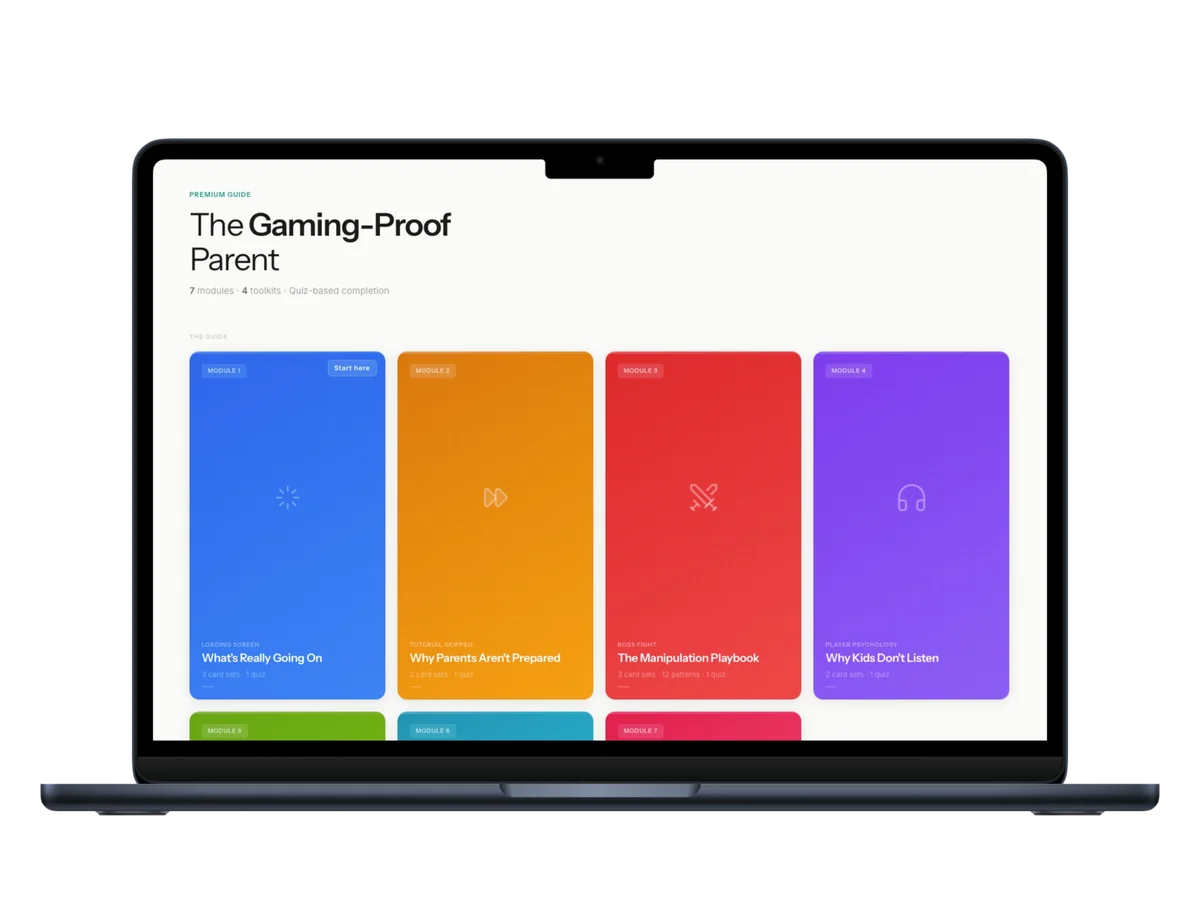
Every game your child plays is engineered to make stopping feel impossible. This guide breaks down exactly how — and gives you the conversations, the boundaries, and the 4-week plan to change it.
Want personalised help instead?
The guide gives you the system. A session gives you a plan built around your child, your family, and your specific situation. One call. 45 minutes. Everything changes.
Your Questions Answered