Is My Child Addicted to Their Phone?
What I See in Every Family.
You have tried taking it away at bedtime. You have tried app limits. You have tried the conversation where you both agree on rules and then nothing changes by the next morning. The phone is the first thing they reach for and the last thing they put down — and you are starting to wonder if this has crossed a line.
for UK teenagers
Your child is not on their phone all day because they lack discipline. Every app on that device — TikTok, Instagram, Snapchat, YouTube — is optimised to keep them scrolling. Screen time coach Daniel Towle, who has worked with over 1,000 families, explains: "Your child is not weak. The product is engineered. Every notification, every infinite scroll, every like counter is there for a reason — and it is not your child's wellbeing."
You have probably seen this pattern
You do not need to check every box. One is enough to know this matters.
You Are Still Reading. That Usually Means Something.
Why Your Child Cannot Put Their Phone Down (It Is Not Weakness)
Your child is not on their phone all day because they lack discipline. Every app on that device — TikTok, Instagram, Snapchat, YouTube — is optimised to keep them scrolling. Screen time coach Daniel Towle, who has worked with over 1,000 families, explains: "Your child is not weak. The product is engineered. Every notification, every infinite scroll, every like counter is there for a reason — and it is not your child's wellbeing."
A phone is not one product. It is dozens of products competing for your child's attention simultaneously. Each app uses the same psychological toolkit: variable reward schedules (you never know what the next scroll will show), social validation loops (likes, comments, streaks), artificial urgency (disappearing stories, streak counters), and infinite content feeds (there is no natural stopping point).
For a developing brain, this combination is especially powerful. The prefrontal cortex — the part responsible for impulse control and long-term decision-making — is not fully developed until the mid-twenties. Asking a 12-year-old to self-regulate against systems built by professional psychologists is not a fair fight. It is like asking them to out-negotiate a team of lawyers.
Is It Normal or Is It a Problem? The Signs That Actually Matter.
Daniel Towle, a screen time coach featured in The Washington Post, says the question is not how many hours your child spends on their phone. "Hours are a distraction. The question is: what happens when the phone is not available? The reaction tells you more than the screen time report ever will."
Every child uses their phone. That is normal. What I look for in families is not the amount of use — it is the impact and the inability to stop. A child who is always on their phone but still sleeps well, does homework, and has friends offline is in a very different place from a child who cannot get through a meal without checking it.
What the Phone Is Actually Giving Your Child
Screen time coach Daniel Towle, who spent 8 years as Head of Technology in London schools, says the phone is never just a phone. "Every child I work with is meeting a real need through their screen. Until you understand what that need is, taking the phone away just creates a vacuum — and the meltdown that follows is genuine distress, not defiance."
This is the part most advice on how to stop phone addiction gets wrong. The standard approach is to take the phone away first and ask questions later. But restriction without understanding is why the rules never stick. Here are the four needs I see the phone meeting in almost every family:
The phone is not the problem. The phone is the symptom. Until you understand what need it is meeting — social connection, validation, escape, stimulation — you cannot build a replacement. And without a replacement, restriction just creates conflict.
— Daniel Towle, Digital Family CoachSocial Connection
For many children, their social life lives on their phone. Group chats, Snapchat streaks, Instagram DMs — taking the phone away does not just remove an app. It removes their connection to their friend group. "When parents tell me they took the phone away and their child was devastated, I ask: did you also remove their ability to talk to every friend they have?" says Towle.
Identity and Validation
Likes, comments, followers — for a teenager, these are not vanity metrics. They are social currency. The phone is where they build and maintain their identity. For children who struggle with confidence, the phone can feel like the only place where they are seen and valued.
Escape and Regulation
Scrolling is soothing. When school is stressful, family life is tense, or the world feels overwhelming, the phone offers an instant escape into content that requires nothing from them. For children with ADHD or anxiety, this is especially powerful — the phone provides stimulation and regulation that their brain is actively seeking.
Entertainment Without Effort
A phone delivers unlimited entertainment with zero effort. No setup, no planning, no asking for permission. Every other activity requires more from them — which is why "go read a book" has never worked as an alternative. The replacement has to be genuinely compelling, not just available.
What Actually Changes the Dynamic (From 1,000+ Families)
Screen time coach Daniel Towle has found that the families who successfully manage phone use are not the ones with the strictest rules. They are the ones who understand why their child is on the phone, address the underlying need, and build structure that the child helped create. "Rules that your child has no ownership of will be broken. Rules they helped write tend to stick," says Towle.
Understand the Product Before You Restrict It
Most parents restrict the phone without ever spending time on the apps their child uses. When you actually experience how these apps are designed — how they learn what holds your attention, how they create daily pressure, how they time notifications to pull you back — your whole perspective shifts. You stop blaming your child and start seeing the product for what it is.
Name the Problem Together
Children are surprisingly receptive when you frame phone use as "they are doing this to you" rather than "you are doing this wrong." The moment the blame shifts from child to product, the conversation changes completely. But the way you introduce this matters — the wrong framing shuts them down, the right framing opens them up. The guides walk you through exactly how to have this conversation.
Build Rules They Helped Write
The families who get phone use under control are not the ones with the longest list of restrictions. They are the ones where the child had a say in building the boundaries. Rules that your child has no ownership of will be broken. Rules they helped write tend to stick. The structure matters — what you include, how you phrase it, and how you introduce it makes the difference between a family agreement that lasts and one that falls apart within a week.
Replace, Do Not Just Remove
Taking the phone away without understanding what it was providing leaves a gap your child will fight to fill. The phone is meeting a need — social connection, escape, stimulation, or all three. "Go outside" is not a replacement. Until you identify what the phone is actually doing for your child and address that specific need, every restriction will feel like punishment rather than progress.
I Got Hooked on My Own Phone. As an Adult.
Daniel Towle did not just study phone addiction academically. He experienced it — as a teenager who could not stop gaming, and later as an adult who fell into the same trap with TikTok.
I already knew everything about how these apps work. I teach this for a living. And I still got pulled in. While building Digital Family Coach, I started creating content on TikTok. Within weeks, I was scrolling for hours instead of creating. The same dopamine loop. The same "just five more minutes." The same guilt afterwards.
I do not judge parents who are struggling with this. I do not judge children either. I have been on both sides. I know the pull is real because I have felt it myself — as a teenager with games, and as an adult with an app I was supposed to be using for work. Understanding does not make you immune. But it does make you informed.
— Daniel Towle, Digital Family CoachThat experience changed how I offer phone addiction help to families. I stopped saying "just set a timer" because I know that does not work — not for a teenager, and not for a 40-year-old who knows better. The pull is real. It is not a character flaw. It is a design feature.
When a parent tells me their child is on their phone all day and they do not understand how, I say: have you downloaded TikTok yourself? Have you opened it at 8pm and looked up to find it is 10pm? Most parents who try this come back to me and say, "I get it now." That is where the real conversations start.
When Should You Get Professional Help for Phone Use?
Daniel Towle, a screen time coach who has supported over 1,000 families, recommends seeking professional phone addiction help when phone use is consistently harming your child's sleep, education, relationships, or mental health — and when your own attempts to manage it have repeatedly failed. "If you have tried setting rules three times and they have collapsed three times, that is not a parenting failure. That is a signal you need a different approach," says Towle. The NHS Every Mind Matters resource can also help you assess the situation.
Try Consistent Rules First
Set clear phone-free zones and times. Charge the phone outside the bedroom. No phones at meals. Try this consistently for two full weeks before deciding it is not working. Most families give up after three days.
Use the Platform Guides on This Site
Set up parental controls on each platform your child uses. Our guides for TikTok, Instagram, and YouTube Shorts walk you through exactly what to enable and why.
If That Has Not Worked — Book a Session
A 45-minute video call with Daniel gives you a personalised plan built around your child, their specific apps, and your family dynamics. One session. A written action plan. Conversation scripts you can use that evening. Most families only need one call.
More from the Screen Time Series
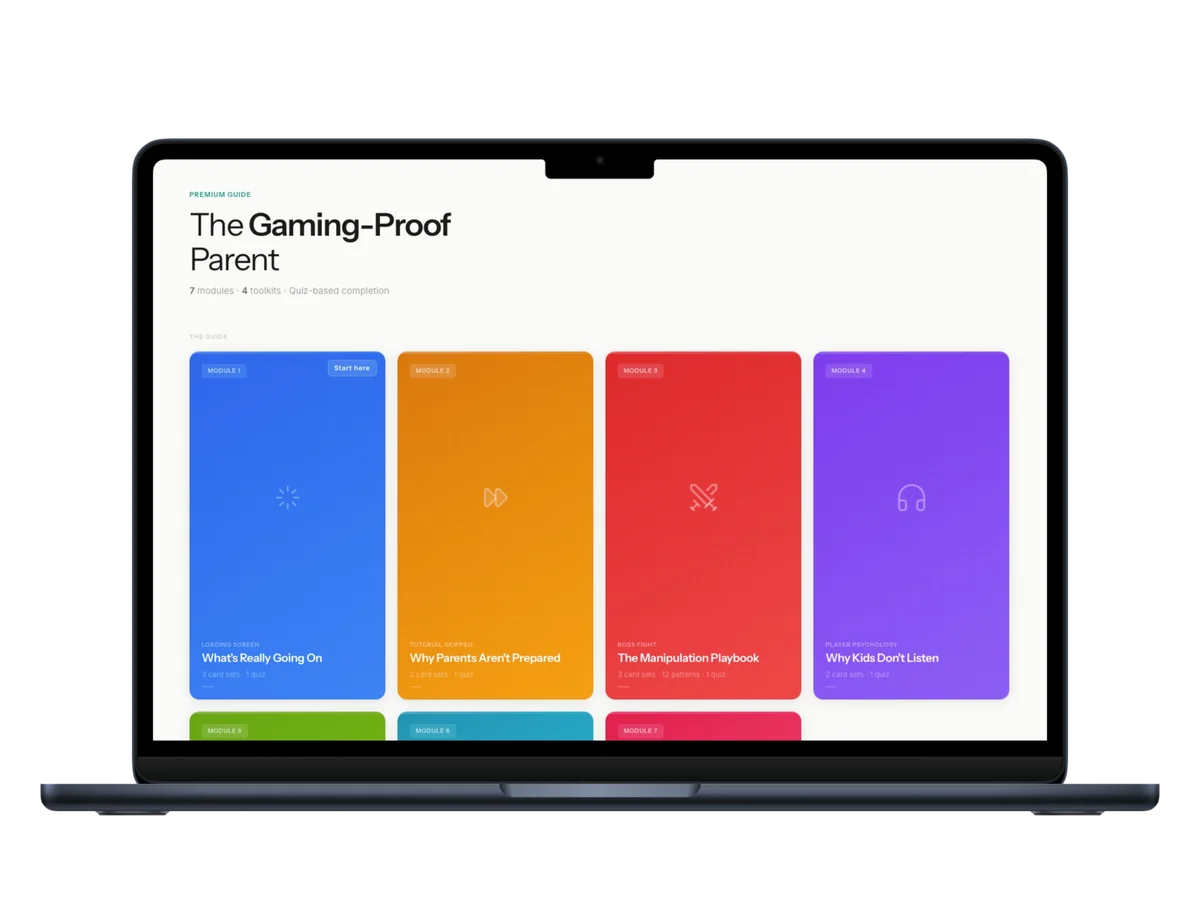
Every game your child plays is engineered to make stopping feel impossible. This guide breaks down exactly how — and gives you the conversations, the boundaries, and the 4-week plan to change it.
Want personalised help instead?
The guide gives you the system. A session gives you a plan built around your child, your family, and your specific situation. One call. 45 minutes. Everything changes.
Your Questions Answered