Child Sneaking Phone
at Night?
You found the phone under their pillow. Again. You've taken it away, set charging stations, even hidden it — and somehow it's back in their hands at 2am. You're starting to wonder if your child has a genuine problem or if you're just not handling this right.
phone in the bedroom
You have probably tried this already
You do not need to check every box. One is enough to know this page is for you.
Why Your Child Sneaks Their Phone at Night — And Why Punishment Makes It Worse
Your child isn't sneaking their phone because they're disobedient. The phone is optimised for exactly the conditions that exist at night — dark room, no competing demands, a brain too tired to exercise self-control. Having a phone in bedroom at night gives the apps their best window. Night-time is when the phone has the most power over your child.
Notifications are the trigger. Even with the phone on silent, your child knows messages are arriving. Group chats move fast — by morning, they'll have missed 200 messages and be completely out of the loop. For a teenager, that social cost feels enormous. Bigger than the risk of getting caught.
Then there's the scroll. TikTok, Instagram Reels, and YouTube Shorts use infinite scroll with no natural stopping point. Each video is 15–60 seconds, which means the "just one more" commitment feels tiny. Three hours later, they genuinely don't know where the time went. That's not an exaggeration — it's how short-form video is designed to work.
Melatonin suppression makes it worse. Blue light from screens is particularly harsh on children — their eyes are more sensitive to it than adults', so the effect on their sleep signal is stronger. The blue light delays their natural sleep signal, so they genuinely don't feel tired even when they should be exhausted. They're not lying when they say they're not sleepy. The screen has chemically delayed the signal their body would normally send.
For children with ADHD, the combination is particularly powerful. Time-blindness means three hours feels like 30 minutes. The constant novelty of scrolling feeds the dopamine-seeking brain perfectly. And the hyperfocus that makes it impossible to stop gaming works exactly the same way with phones.
What Night Phone Use Is Actually Doing to Them
The phone at night creates a cycle: less sleep means less impulse control, which means more phone use, which means less sleep. A child who won't sleep because of their phone isn't choosing to be difficult — they're trapped in a loop the platform is designed to sustain. It accelerates faster than most parents realise, and the effects show up in places you wouldn't expect.
School Performance
A child running on 4–5 hours of sleep can't concentrate, can't retain information, and often gets misidentified as having attention problems. The teacher sees a child who can't focus. You know it's because they were scrolling TikTok at 3am.
Emotional Volatility
Sleep deprivation strips away emotional regulation. The rage when you take the phone away at 6pm started at 2am the night before. They're not being difficult — they're running on fumes and can't regulate anything.
Social Comparison at the Worst Time
At 2am, your child is comparing themselves to curated highlight reels while their defences are at their lowest. The body image anxiety, the social exclusion fear, the "everyone's life is better than mine" spiral — all of it hits hardest when they should be asleep.
The Trust Damage
Every time they sneak the phone and get caught, another layer of trust erodes. They feel guilty. You feel betrayed. The conversation about the phone becomes loaded with resentment on both sides. The phone stops being about screen time and starts being about honesty.
Why Confiscation Creates Sneakier Children, Not Safer Ones
You've probably tried taking the phone away at night. Most parents have. And for a few days, it works. Then they find the old tablet. Or borrow a friend's phone. Or discover they can use a school laptop to access social media. The motivation to access the phone at night is stronger than any barrier you can create — because the barrier only addresses the access, not the pull.
Confiscation without understanding teaches one thing: be better at hiding it. A child who understands why the phone is so hard to put down at night has a tool that works when you're asleep. A child who's simply been denied has a mission.
The mechanics — infinite scroll, variable reward, autoplay — are built specifically to override the kind of attention control a 13-year-old does not yet have. The pull isn't about intelligence or willpower. It's about design. Adults who study these products professionally still struggle to put them down at midnight. Expecting a teenager to resist that same design, alone in a dark bedroom, is unrealistic.
The shift that works is moving from "I'm taking your phone" to "I want you to understand what the phone is doing to you at night." One creates an adversary. The other creates an ally.
Signs the Night Phone Use Has Become a Pattern
Not all phone sneaking is the same. A child who checks their phone once before sleep is different from one who's on it for three hours every night. Pay attention to the pattern, not the single incident.
Critical
Notice whether they're getting progressively more creative about hiding the phone. Notice whether the morning exhaustion is getting worse, not better. Notice whether they panic when the phone is out of reach — even during the day.
Warning
Notice whether their mood has changed since the night phone use started. Notice whether they're withdrawing from activities they used to enjoy. Notice whether they're lying about other things now — not just the phone.
Worth Watching
Notice whether the phone use is social (messaging friends) or solitary (scrolling alone). Notice whether they seem anxious when away from the phone during the day. Ask yourself whether their sleep has deteriorated gradually or suddenly.
Why I Understand the Pull
I spent 12 years as Head of Technology in London schools. I watched thousands of children interact with their phones every day — and I watched the sneaking get more sophisticated every year. By the end, children were using VPNs, second accounts, screen recording to fake screen time reports, and hotspotting off friends' phones to bypass home Wi-Fi restrictions. The creativity would be impressive if the consequences weren't so serious.
That 12-year view of how phone behaviour changes year on year is what shifted my approach. Phone sneaking is not a discipline problem. It is a design problem meeting a developing brain. Framing it as the former means families try to out-parent an engineering team of thousands. Framing it as the latter means families start working with the child, not against them.
The phone isn't broken. Your child isn't broken. The combination of an engineered product and a developing brain creates a situation that willpower alone can't solve. That's not an excuse — it's the starting point for finding something that actually works.
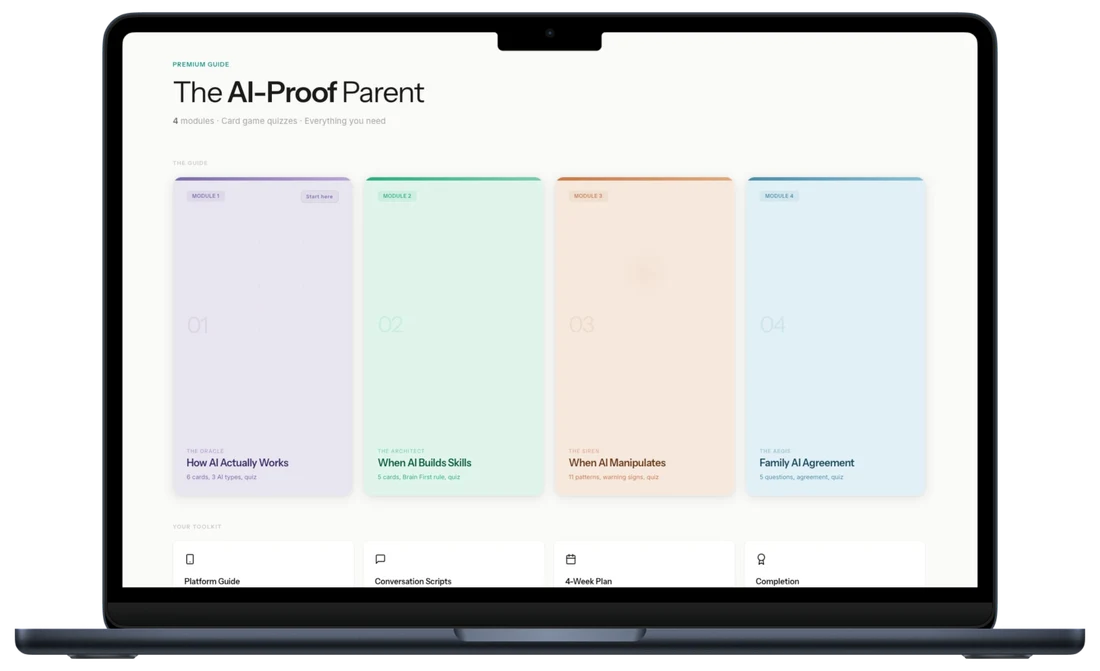
Most children are already using ChatGPT, Character AI, or Meta AI — and most parents have no idea what they are saying. This guide gives you the framework to understand, set boundaries, and have the conversations that matter.
More from the Screen Time Series
I'm autistic and ADHD myself, so I understand how your child's brain works from the inside, not from a textbook. I won't hand you a sticker chart or tell you to "just set firmer limits" - we build a plan around how their brain actually works, because mine works the same way.
Want personalised help instead?
The guide gives you the system. A session gives you a plan built around your child, your family, and your specific situation. One call. 45 minutes. Everything changes.
Questions Parents Ask About Phone Sneaking
Sources & Further Reading
- Sleep Foundation — Electronics in the Bedroom
- NHS Every Mind Matters — Is My Child Spending Too Much Time Online?
- The Washington Post — Kids, Parents & Tech Help (November 2025)
- Royal College of Paediatrics and Child Health — Health Impacts of Screen Time
This article references academic research and clinical guidelines for context. Daniel Towle is not a clinical psychologist or medical professional. The strategies discussed are based on 12 years of practical experience in schools and direct work with families. If you have concerns about your child's mental health, please consult a qualified healthcare professional.