My Child Is Addicted to YouTube.
They Watch for Hours and Can't Stop.
My child watches YouTube all day — and you've tried turning it off, but the meltdown lasted longer than whatever they were watching. You've set timers that get ignored. You downloaded YouTube Kids and the recommendations still got stranger. And now you're starting to wonder if this is normal — or if you're letting something happen that you should have stopped earlier.
from autoplay recommendations
YouTube isn't television. Television has ad breaks, episode endings and schedules — natural stopping points built into the format. YouTube has none. The next video starts automatically. The recommendation algorithm learns exactly what your child responds to. And there is no moment where the screen goes quiet and says "that's it for tonight." Screen time coach Daniel Towle explains why this distinction matters for every parent.
You have probably seen this pattern
You do not need to check every box. One is enough to know this matters.
YouTube Isn't a Parenting Problem. It's a Product Problem.
Why YouTube Is Harder to Turn Off Than Television
YouTube isn't television. Television has ad breaks, episode endings and schedules — natural stopping points built into the format. YouTube has none. The next video starts automatically. The recommendation algorithm learns exactly what your child responds to. And there is no moment where the screen goes quiet and says "that's it for tonight." Screen time coach Daniel Towle explains why this distinction matters for every parent.
The mechanism behind YouTube's pull is something called variable reward. Most videos your child watches are fine — entertaining enough to keep going. But every so often, one is genuinely amazing. A surprise unboxing. A perfectly timed fail compilation. A creator they love doing something unexpected. That unpredictability is the hook. Their brain learns: if I keep watching, something brilliant might be next. It's the same principle that keeps adults scrolling social media — and the same psychology behind slot machines.
Then there's the recommendation algorithm. YouTube doesn't just serve random content. It learns what your child watches, how long they watch it, what they skip, and what makes them click. Within hours, the feed is personalised. Within days, it's optimised for maximum engagement. Your child isn't choosing what to watch — the algorithm is choosing for them, based on what keeps them watching longest.
And the "kids watching other kids open toys" phenomenon? That's not random either. Watching another child play with a toy activates many of the same reward pathways as playing with the toy themselves. It's vicarious reward — the brain gets the dopamine hit without the child needing to do anything at all. That's why they can sit motionless for an hour watching someone else have fun. The reward system doesn't distinguish between doing and watching.
What Autoplay Does to a Young Brain
A child aged 6 to 10 has significantly less prefrontal cortex development than a teenager. The prefrontal cortex is the part of the brain responsible for impulse control, decision-making and knowing when to stop. Asking a young child to self-regulate around autoplay is asking the least developed part of their brain to override the most stimulated part.
Here's what's happening neurologically. Each new video triggers a small dopamine release. Not a huge one — just enough to feel good. But autoplay means that release never stops. There's no gap. No pause. No moment where the brain settles back to baseline. The child enters a state of passive consumption that looks like focus but is actually the opposite. They're not concentrating. They're zoning out while their reward system stays lit up.
That's why you can call their name three times and they don't hear you. It's not defiance. Their auditory processing is genuinely suppressed while the visual reward loop is running. The brain prioritises the stream of stimulation over everything else — including your voice.
There's an important distinction here between interactive play and passive watching. A child building something in Minecraft is making decisions, solving problems, creating. A child watching YouTube is receiving. The brain activity is fundamentally different. That's part of why YouTube is genuinely dangerous for kids in a way passive television never was — the algorithm keeps adapting, so the passive consumption never plateaus. Over time, the brain starts to prefer the easier option. That's when you notice they've stopped drawing, stopped building, stopped playing. Not because they've lost interest in those things. Because YouTube requires less effort for the same reward.
Why "Just Turn It Off" Creates the Meltdown
When you switch off YouTube mid-video, you're not just ending an activity. You're interrupting a dopamine loop at its peak. The child's brain goes from high stimulation to nothing — instantly. That neurological cliff edge triggers a genuine stress response. The meltdown that follows isn't behavioural. It's chemical.
Think of it this way. If someone handed you a cup of tea and then snatched it away after the first sip, you'd be annoyed. If they did it every day, you'd start getting angry before they even reached for the cup. That's what's happening with your child and YouTube. The anticipation of loss becomes part of the stress. They're not just upset about what you took away. They're upset because they know the feeling of it being taken, and their nervous system braces for it.
The meltdown isn't your child showing you their worst side. It's the product showing you what it does. Once parents understand that distinction, the entire dynamic shifts — because you stop blaming the child and start addressing the environment.
— Daniel Towle, Digital Family CoachYour child isn't being defiant. They're experiencing a chemical drop. Dopamine was elevated — now it's plummeting. For a young child whose emotional regulation is still developing, that drop feels overwhelming. It's the same reason adults feel irritable after closing a social media app they were deep into — except adults have decades more prefrontal cortex development to manage the feeling. A six-year-old doesn't.
The product is optimised for this. YouTube has no "episode over" screen. No credits. No natural pause. If the child can't find a stopping point themselves, and the product refuses to provide one, then the only way the session ends is when someone intervenes. And intervention during a dopamine high will always feel like an attack — even when it's done with love.
When Should You Be Worried About YouTube?
Not every child who watches a lot of YouTube has a problem. But some patterns indicate the balance has shifted — and the earlier you recognise them, the easier they are to address. Screen time coach Daniel Towle, who has worked with over 1,000 families, uses these observational markers to help parents assess where their child sits.
I've Watched This in Thousands of Children
I spent 12 years as Head of Technology in London schools — including settings for children with ADHD and autism. Over that time, I watched something change. The children coming into reception could sit and listen for longer periods in 2014 than they could in 2024. The ones who struggled most with sustained attention, with independent play, with transitions between activities — those were overwhelmingly the ones with unrestricted YouTube access at home.
I'm not anti-technology. I'm anti-manipulation. There's a difference. And once you understand where that line sits for YouTube specifically, you can make decisions based on knowledge rather than guilt.
— Daniel Towle, Digital Family CoachI'm not anti-technology. I built my career around it — 8 years as Head of Technology in London schools, teaching children how to use technology every single day. What I observed over 12 years in schools is that these products aren't neutral. They're optimised to hold attention, and young children have the least resistance to that pull.
More from the Social Media Series
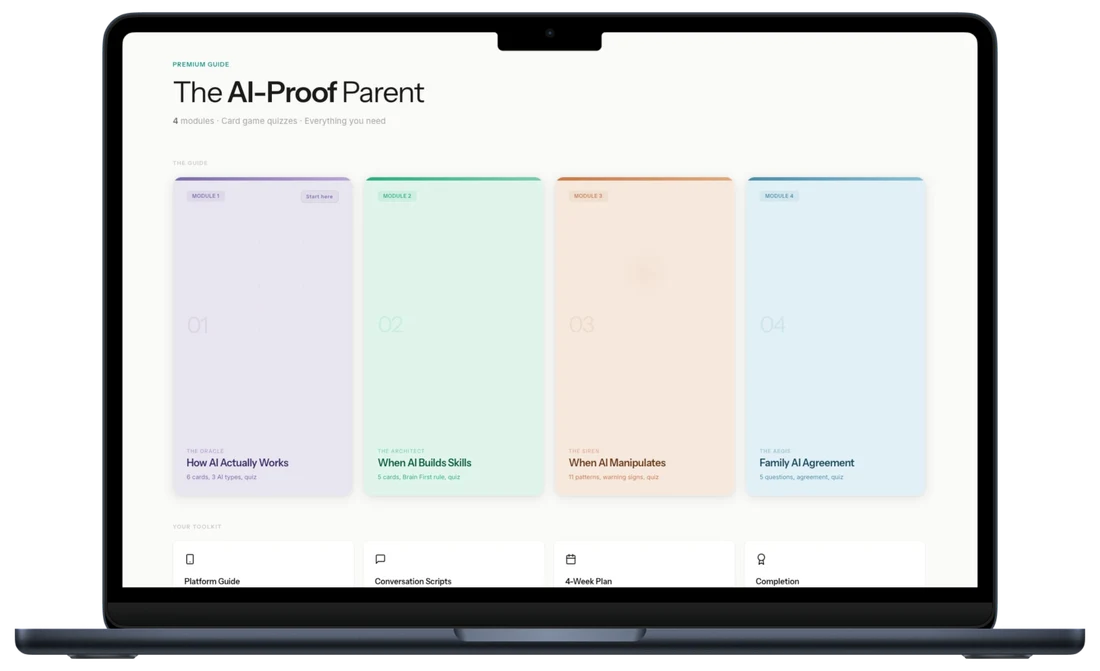
Most children are already using ChatGPT, Character AI, or Meta AI — and most parents have no idea what they are saying. This guide gives you the framework to understand, set boundaries, and have the conversations that matter.
Want personalised help instead?
The guide gives you the system. A session gives you a plan built around your child, your family, and your specific situation. One call. 45 minutes. Everything changes.
Your Questions Answered