Gaming Is Destroying
My Family
You didn't set out to become the bad guy. But somewhere between the third meltdown this week and the argument with your partner about what to do, that's what it started to feel like. The game isn't just a problem for your child anymore. It's a problem for everyone.
causes family conflict
When gaming is destroying your family, the real issue is rarely the gaming itself. The game is filling a need your child can't meet another way — connection, regulation, escape, status. Cutting access without understanding what it replaces makes things worse. What changes the dynamic: understand the product first, then rebuild structure around what the game was providing.
Who this guide is for: parents whose child's gaming is fracturing the family — arguments every evening, meltdowns when you turn the console off, tension between you and your partner about how to handle it, quieter siblings feeling invisible. If that's the shape of your week, keep reading.
You have probably been through this
You do not need to check every box. One is enough to know this page is for you.
Why Gaming Doesn't Just Affect Your Child — It Affects Everyone
Gaming doesn't stay in one room. It leaks into mealtimes, bedtimes, mornings, holidays, and the space between you and your partner. The reason it feels like it's destroying your family is because it's filling roles that the family used to fill — and nobody told you that was happening.
Sources: Internet Matters 2025, Ofcom 2025
Here's what most advice gets wrong. They treat gaming as a child problem. It isn't. By the time a parent is searching "gaming destroying my family," the problem has metastasised. It's in the marriage. It's in the sibling dynamic. It's in the atmosphere of the house when you walk through the door after work.
The game is meeting needs your child used to get from the family — belonging, achievement, identity, control. Not because you failed to provide them. Because the game provides them more efficiently, more immediately, and without the friction that real relationships involve. Your child isn't choosing a game over you. They're choosing the path of least emotional resistance — which is exactly what the product was optimised to be.
Three Patterns That Make It Worse
Most families fall into one of three patterns. All three feel logical in the moment. All three escalate the problem. If you recognise yours, you're not failing — you're dealing with something you were never given the tools to handle.
The Enforcement Loop
One parent sets rules. The child resists. The other parent thinks the rules are too harsh — or too soft. The argument shifts from child-vs-parent to parent-vs-parent. The child learns that resistance works, because eventually someone gives in. The game stays on. The resentment builds.
Walking on Eggshells
You've learned that asking them to stop triggers a meltdown. So you stop asking. You let it slide. The house is quieter, but the problem gets bigger every week. Your child has learned that their mood controls the household — and they didn't even do it on purpose. The game did it for them.
The Guilt-Anger Cycle
You lose your temper. You feel guilty. You overcompensate by being lenient. The cycle repeats. Meanwhile, you're starting to resent your own child — and the shame of that feeling makes everything harder. You're not a bad parent for feeling this. You're a normal parent in an abnormal situation.
I see these patterns in almost every family I work with. The parents who break out of them don't do it by being stricter or more lenient. They do it by understanding what the game is actually giving their child — and building a conversation around that instead of around the rules.
— Daniel Towle, Screen Time CoachThe Part Nobody Talks About: What It Does to You
Every article about gaming addiction focuses on the child. Almost none of them talk about what it does to the parent. The exhaustion. The guilt. The creeping feeling that you're failing at something every other family seems to manage. That feeling is not a sign of weakness. It's a sign of how well the product works.
The isolation is the worst part. You can't talk about it at school drop-off because it sounds like you can't control your own child. You can't talk about it with your partner because you've already had the same argument fifteen times. You can't talk about it with your parents because they'll say "just take it away" — and you've already tried that.
So you carry it alone. And the longer you carry it, the heavier it gets. The resentment towards your child builds. The distance between you and your partner grows. The siblings start acting out because negative attention is still attention. And the game — the game just keeps running.
This is not a parenting failure. These products employ teams of psychologists, data scientists, and behavioural designers whose entire job is to maximise engagement. Your child's prefrontal cortex — the part that handles impulse control — won't fully develop until their mid-twenties. Asking a child to self-regulate against that is like asking them to out-negotiate a team of professionals. The game isn't a fair fight. And neither is dealing with its fallout alone.
What Actually Changes the Dynamic?
The families who break through this don't do it by being stricter. They do it by getting on the same page — with each other first, and then with their child. The shift happens faster than most parents expect, and it starts with something most families have never tried.
The breakthrough moment in almost every family I work with is the same: the parents stop fighting about the rules and start understanding the product. When both parents can explain why their child can't stop — what Fortnite's battle pass is doing, why Roblox's limited items create artificial urgency, how Minecraft's open-ended world becomes a child's only source of control — the argument changes. It stops being "you're too strict" vs "you're too soft" and becomes "we both understand the problem now. What do we do about it?"
That shift — from fighting each other to facing the same direction — is what changes everything. The rules stop being arbitrary. The conversations with your child stop being lectures. And the siblings stop feeling invisible, because gaming isn't the only thing the family talks about anymore.
What Every Family Needs to Understand First
- The game didn't break your family — it found existing pressure points and amplified them
- Both parents need to understand the product before any rule will stick
- Your child isn't choosing the game over you — they're choosing the path of least emotional resistance
- The goal isn't zero gaming — it's a family where gaming isn't the central conflict
What works vs what makes it worse
| Makes it worse | What actually changes the dynamic |
|---|---|
| Cold-turkey bans | Understand what the game replaces first |
| Bribing or removing screen time as punishment | Change structure, not just hours |
| Parents disagreeing in front of the child | Both parents align BEFORE speaking to the child |
| Taking games away in anger | Predictable 15-minute warning system |
| Screen time rules without understanding the product | Learn what the game is actually doing (start with our 2-min gaming assessment) |
| Making gaming the only conversation | Rebuild what gaming was filling (connection, regulation, escape) |
Here's what gives me hope: Most families see meaningful change within weeks — not months. The shift usually happens when both parents stop fighting each other and start understanding the product together. Once you both see the mechanics, the arguments lose their heat. And your child notices.
Why This One Hits Different for Me
I've spent 12 years in schools watching families fragment over screens. But it's not just professional. I noticed gaming becoming a problem for me as a teenager — twice — and I built my own system to manage it before it got worse. I know what the pull feels like. And I know what it looks like when a family starts to fracture around it.
The families I worry about most aren't the ones where the child plays too much. They're the ones where the parents have stopped talking to each other about it. Where one parent has given up. Where the siblings have gone quiet. That's when gaming has stopped being a child problem and become a family problem — and that's when the usual advice about screen time limits becomes completely useless.
Every family is different. You get to decide how you parent. But when you're not given the right information about what these products actually do, it's very hard to make the right choice. That's exactly what I help parents do — not by telling them what to do, but by showing them what they're dealing with.
The parents who turn this around aren't the ones with the best rules. They're the ones who finally understand what the game is actually giving their child — and they use that knowledge to have conversations that change the dynamic. Not lectures. Not ultimatums. Conversations.
— Daniel Towle, Screen Time CoachWhen Should You Get Help?
If you're reading this page, you've probably already tried multiple approaches and none of them have held. That's not a parenting failure — it's a signal. The question isn't whether gaming is a problem. It's whether it's become a family-wide problem that needs a different kind of support.
The NHS Every Mind Matters resource covers individual screen time concerns. But when gaming is affecting the whole family — the marriage, the siblings, the atmosphere — a different kind of conversation is needed.
- Gaming arguments are causing genuine damage to your relationship with your partner
- Siblings are being emotionally neglected because one child dominates all the energy
- Your child becomes aggressive or violent when gaming is interrupted
- You or your partner have disengaged completely from trying to address it
- You've started to feel resentment towards your own child
- You and your partner consistently disagree about the approach
- Gaming is causing daily arguments in the household
- Family activities have dried up because they always end in conflict
- You've tried setting limits multiple times and they never hold
- Your child's mood dictates the atmosphere of the entire house
- Notice whether the tension is about gaming specifically or screens in general
- Pay attention to whether both parents are still communicating about it
- Ask yourself: when was the last time the whole family enjoyed something together?
More from the Gaming Series
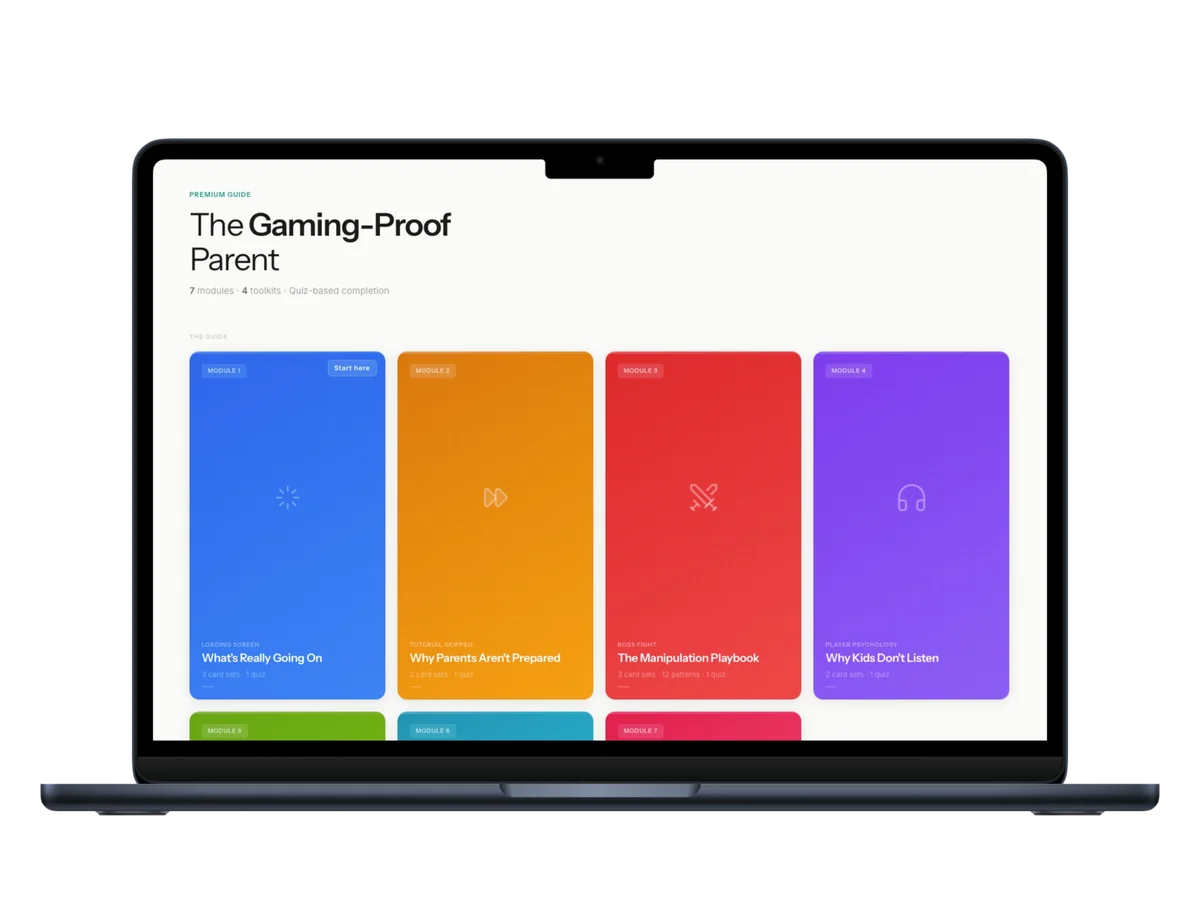
Every game your child plays is engineered to make stopping feel impossible. This guide breaks down exactly how — and gives you the conversations, the boundaries, and the 4-week plan to change it.
Want personalised help instead?
The guide gives you the system. A session gives you a plan built around your child, your family, and your specific situation. One call. 45 minutes. Everything changes.
Questions Parents Ask About Gaming
Sources & Further Reading
- World Health Organization — Gaming Disorder (ICD-11, 6C51)
- American Academy of Pediatrics — Media and Children
- NHS Every Mind Matters — Is My Child Spending Too Much Time Online?
- The Washington Post — Kids, Parents & Tech Help (November 2025)