Is Roblox Safe
for My Child?
With 100+ million daily active users and 40% under 13, Roblox is one of the largest platforms your child will ever use — and one of the most misunderstood by parents.
under 13
You have probably noticed something
You do not need to check every box. One is enough to know this page is for you.
Is Roblox safe for kids? (2026)
Only with strict parental controls and active supervision. Roblox is rated ESRB T (Teen 13+), but the platform has no minimum age of its own. In March 2026, an independent Roblox developer told BBC Radio 5 Live that parents “should monitor children 24/7” on the platform. The Guardian (April 2025) called the risks to children on Roblox “deeply disturbing”. The platform itself acknowledges children “may be exposed to harmful content and bad actors”.
What Is Roblox and Why Do Kids Love It?
Roblox is not a single game — it is a platform hosting 44+ million user-created games and experiences. Kids can play, create, and chat with others. It is free to play but makes billions through Robux, the in-game currency. The appeal is endless novelty — there is always something new to try, and “everyone at school is on it.”
Unlike traditional games with defined endings, Roblox is designed for perpetual engagement. New experiences launch constantly. Social pressure keeps children coming back. And because anyone can create content, quality and safety vary wildly — from innocent obstacle courses to experiences that have exposed children to sexual content.
Is Roblox Safe for Kids?
Roblox is not safe by default. A 2025 investigation by Revealing Reality (reported in The Guardian) found adults can interact with children as young as 5, and 10-year-old accounts accessed sexually suggestive content despite restrictions. With proper setup, risks reduce significantly — but knowing the settings is not enough. It is how you supervise and the conversations you have that make the difference.
Most parents assume Roblox is safe because it looks child-friendly. The colourful avatars and blocky graphics mask serious risks. The difference between safe and dangerous Roblox use comes down to about 15 minutes of setup — but technology alone will not protect them.
Why Can't My Child Stop Playing Roblox?
Roblox is infinite by design — millions of games, constant updates, and social pressure to keep up. The Robux economy creates artificial scarcity and spending pressure. With $3.6 billion in 2024 revenue from 82.9 million daily users spending 73.5 billion hours annually, this is not accidental. Your child is not playing one game; they are in an environment where stopping means missing out.
Unlike a traditional video game with levels and an ending, Roblox has no conclusion. There is always another game to try, another experience launching, another friend asking them to join. This infinite structure means there is never a natural stopping point — every moment feels like the wrong moment to quit.
Social status and virtual items. Robux is not just currency — it is social capital. Limited-time items create FOMO. Children without the “right” avatar accessories can feel left out. The spending pressure is not accidental; it is the business model.
Why this matters for your child. The design taps into how children’s brains work — immediate rewards, social belonging, endless novelty. Your child is not weak-willed; they are responding exactly as intended to technology built by thousands of engineers. Understanding this changes how you approach the conversation.
What Are the Dangers of Roblox?
The main dangers are predator contact, inappropriate user-generated content, addictive design, and spending pressure. With 44 million games, quality control is impossible. Children stumble into adult-themed experiences rated “Mild.” The 2025 Revealing Reality investigation found adults could interact with children as young as 5.
A major investigation published in April 2025 by Revealing Reality (reported in The Guardian) found “deeply disturbing” evidence of adults preying on children through Roblox.
Key Findings
- Adults can interact with children as young as 5 — a test account posing as a 42-year-old could add children as young as 5 as friends
- Private chat with teenagers — the same account could privately chat with accounts aged 13+
- 10-year-olds accessing suggestive content — despite parental controls being in place
- 30+ arrests since 2018 — for abducting or sexually abusing children groomed on Roblox
Legal actions are mounting. Louisiana’s Attorney General sued Roblox, alleging “systematic failure to keep children safe.” Florida issued a subpoena investigating marketing to children and safety policies. Turkey, Kuwait, and Qatar have blocked the platform entirely.
ADHD and autistic children are particularly vulnerable. After 12 years working with children with ADHD and autism, I have seen Roblox hit neurodivergent kids harder. The endless novelty mimics how their brains crave stimulation. The social aspect feels safer than real-world interaction. But the dopamine cycle is more intense, and breaking the habit is harder.
Here is what gives me hope: Every family I have worked with who has set clear Roblox boundaries has seen improvements within 2-3 weeks. The spending stops, the meltdowns reduce, and your child starts re-engaging with the real world. It is not easy — but it works.
Is Murder Mystery 2 (MM2) Safe for Kids?
Murder Mystery 2 (MM2) is one of the most-played Roblox games — over 6 billion visits. The name sounds alarming but the in-game violence is cartoon-style (no blood, no gore, characters simply vanish). The real risks are NOT about violence: they are trading scams, social pressure to own rare knives, in-game chat with strangers, and Robux spending pressure. Most parents worry about the wrong thing with this game.
What MM2 actually is. Players are randomly assigned one of three roles each round — Murderer (knife), Sheriff (gun), or Innocent. Rounds are short. The Murderer tries to eliminate players; the Sheriff tries to stop them. Cartoon characters, no graphic content.
The age rating. MM2’s Roblox content rating is “Moderate” — players under 9 need parental consent. Generally appropriate from around age 12 with Roblox parental controls configured. Not recommended for under-9s because of the trading economy and chat features, not because of the gameplay itself.
The real MM2 risks (in order)
- Trading scams — rare knives function as in-game currency. Scammers target younger players, swapping low-value items for valuable ones, or vanishing mid-trade. Children under ~12 cannot evaluate item values critically.
- Open chat with strangers — standard Roblox risk applied to a game where chat happens between rounds with players of any age.
- Robux spending pressure — the collecting compulsion drives requests for Robux to buy or trade-for rare knives.
- Confusion with the Netflix film — Google often conflates the Roblox game with the PG-13 Netflix film of the same name. Different topic entirely.
If your child wants to play MM2: set Roblox chat to Friends Only (or No One for under-10s), disable trading entirely for younger children, cap Robux spending, and have a direct conversation about how trading scams work before they encounter one. The general Roblox parental controls covered above apply to MM2 in full.
Why Does My Child Get Angry When I Turn Off Roblox?
Roblox triggers are different from other games. Your child is not just losing screen time — they are being removed from their social world mid-conversation, mid-trade, mid-game with friends. The anger comes from social interruption plus dopamine withdrawal simultaneously. Understanding this does not excuse the behaviour, but it changes how you address it.
The social dimension. When you turn off Roblox, your child does not just stop playing — they go offline in front of their friends. For many children, this feels shameful. They were mid-conversation, mid-game, maybe mid-trade. The abruptness is not just about the game ending; it is about social disruption they did not choose.
The dopamine crash. Roblox provides constant micro-rewards — new games to discover, items to earn, friends to chat with. Stopping abruptly removes that dopamine supply. A longitudinal fMRI study (2025) found screen restriction triggers brain activity changes “that may reflect withdrawal-related processes.” The rage you see is not defiance; it is neurochemistry.
Give warnings (15 minutes, 5 minutes, 1 minute). Let them finish their current game or trade. Create a ritual for saying goodbye to friends. These are not rewards for bad behaviour — they are strategies that reduce meltdowns for everyone.
What Do Most Parents Get Wrong About Roblox?
“My child is playing with friends, so it is social”
Kids believe their friends are online but they are not really playing together. It is parallel play at best. Do not let Roblox replace real-world social development.
“Parental controls will fix it”
Controls give parents a false sense of security. A 2025 investigation found a 10-year-old accessing inappropriate content despite restrictions. Technology alone will not fix this.
“I should just ban Roblox”
Outright bans often backfire — kids find workarounds, play at friends’ houses, or feel isolated. Boundaries plus conversations beat bans.
“Taking it away without explanation”
You have just taken away the dopamine rush without explaining why. The brain does not have time to respond — and therefore they will argue. Explain the why.
“It is just a game”
It is not just a game — it is a system that keeps kids playing and spending. The 7+ age rating does not reflect predator risk, spending pressure, or addictive mechanics.
I know why your child can't stop
Games hijack a child's sense of progression. I have progressed in so many games — days, weeks, months — but it does not lead to anything in real life. That is the problem. As a kid, when school feels hard or parents are applying pressure, being able to play a game that is far more fun and feel like you are progressing... it is beneficial in that moment, but it comes with addictive tendencies. Roblox, with its endless user-generated content and constant novelty, never lets that feeling end.
Daniel Towle — Screen Time Specialist, Washington Post FeaturedWhat Age Is Roblox Appropriate For?
Roblox is rated 7+ by PEGI, but this does not account for predator risk, spending pressure, or the 44+ million user-generated games that slip through moderation. Under 9: whether they should be on Roblox at all depends on supervision capacity. Ages 9-12: the critical window where protection must balance with growing independence. Ages 13+: they need to learn self-regulation, not just restrictions.
Generic advice like “set it to Minimal” is not enough. What works depends on your child’s maturity (not their birthday), whether they have ADHD or autism (Roblox’s repetitive loops are particularly compelling for neurodivergent children), and what has already happened (prevention looks different from intervention).
What the Data Actually Shows
Insights from Daniel’s 12 years working in London schools
Is My Child Addicted to Roblox?
Not every child who loves Roblox is addicted. But if it is causing regular distress, affecting school or sleep, and they cannot stop despite wanting to — these are warning signs. The key question: is Roblox enhancing their life or taking from it?
- Physical aggression or destroying property when Roblox is interrupted
- Threats of self-harm related to restrictions
- Evidence of chatting privately with unknown adults
- Complete social isolation — refusing school, friends, leaving room
- Stealing money or payment details for Robux
- Extreme reactions to stopping — rage, tears, complete shutdown
- Declining school performance linked to gaming
- Obsession with Robux — constant requests, anger when refused
- Social withdrawal — preferring online friends to real life
- Secrecy about what they are doing on the platform
- Mild disappointment when stopping but transitions to other activities
- Maintains other interests alongside Roblox
- Happy to show you what they are doing
- Responds to limits when set consistently
More from the Gaming Series
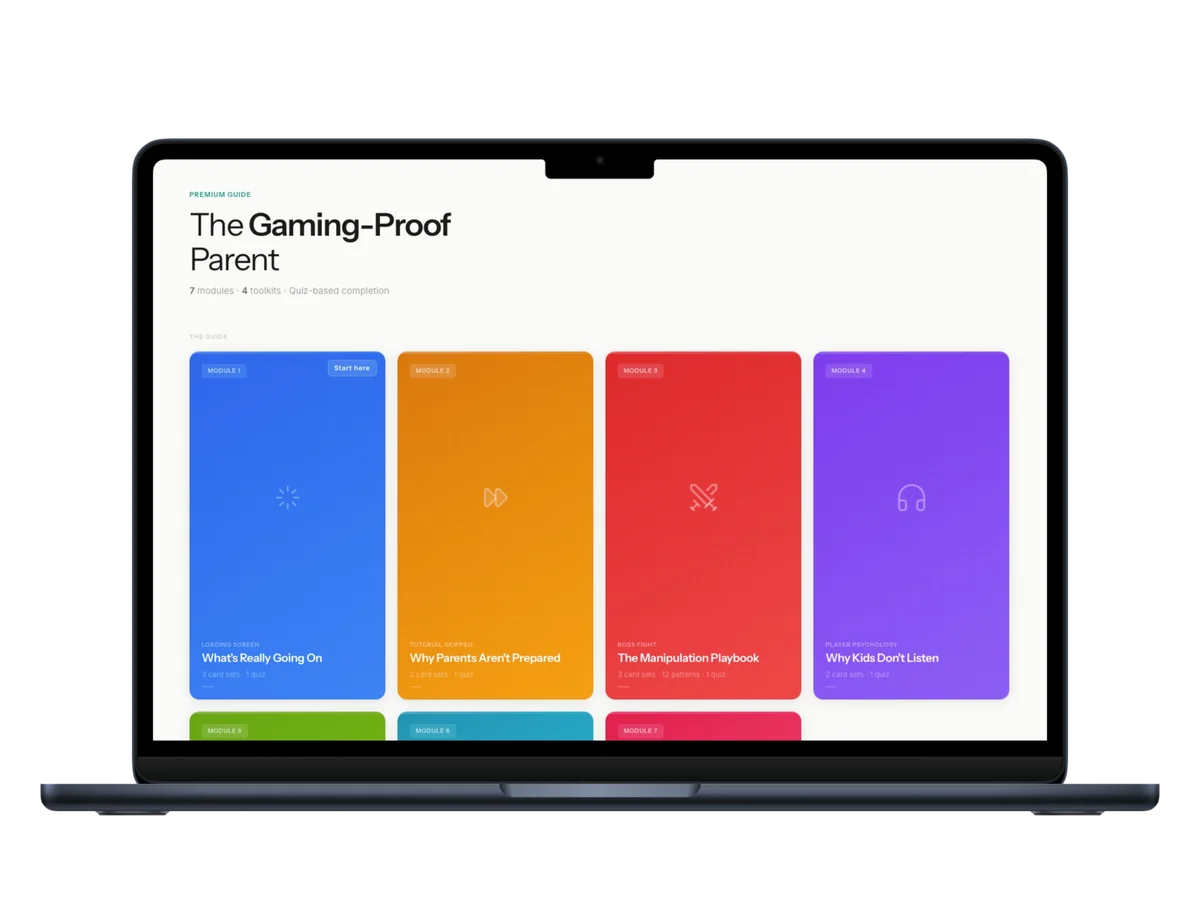
Every game your child plays is engineered to make stopping feel impossible. This guide breaks down exactly how — and gives you the conversations, the boundaries, and the 4-week plan to change it.
Want personalised help instead?
The guide gives you the system. A session gives you a plan built around your child, your family, and your specific situation. One call. 45 minutes. Everything changes.
Your Questions Answered