My Child Stays Up
All Night Gaming
You have set the rules. You have taken the console. You have had the arguments. They are still gaming at 2am. Here is what is actually going on.
past midnight regularly
You have probably seen this before
You do not need to check every box. One is enough to know this page is for you.
Why Your Child Games at Night — And Why It's Not Just Defiance
Night gaming isn't your child choosing to be disobedient. Games are optimised for exactly the conditions that exist at night — low supervision, no competing demands, and a brain that's too tired to exercise impulse control. Night-time is when the game has the most power over your child's brain.
At night, the prefrontal cortex — the part of the brain responsible for impulse control — is depleted from a full day of self-regulation at school. The game provides stimulation that the tired brain craves. It's genuinely easier to keep playing than to stop. That's not a character flaw. That's neurochemistry.
Melatonin production is suppressed by screen light, which makes the child feel less tired even when they should be exhausted. They're not lying when they say they're not sleepy — the screen has genuinely delayed the signal. Add to that the fact that many games have events, updates, or friends online specifically at night. Fortnite updates drop at odd hours. Friend groups in different time zones come online late. The game is optimised for exactly the moment your child should be sleeping.
For children with ADHD, the time-blindness aspect is particularly powerful. Three hours genuinely feels like 30 minutes in a flow state. They're not choosing to ignore the clock — they've lost the ability to perceive time accurately. It's one of the reasons ADHD and night gaming so often go together.
Why Night Gaming Hits Harder Than You'd Think
Sleep deprivation from night gaming creates a cycle that makes the gaming worse. A tired child has less impulse control, which makes them more susceptible to the game's pull, which means longer sessions, which means less sleep. It's a downward spiral — and it accelerates faster than most parents realise.
Academic Performance
Sleep-deprived children can't concentrate, can't retain information, and often get misidentified as having attention problems they don't actually have. The teacher sees a child who can't focus. The parent sees a child who was gaming at 3am. Nobody connects the dots until the grades collapse.
Emotional Regulation
A child running on 4 hours of sleep is going to rage harder when the game is turned off. The anger that scares you at 6pm started at 3am the night before. Sleep deprivation doesn't just make them tired — it strips away the emotional regulation they need to handle any frustration.
Physical Health
Growth hormone is primarily released during deep sleep. Chronic night gaming during key developmental years has consequences beyond tiredness. The body does its most important repair work between 10pm and 2am — exactly the hours the game is stealing.
Mental Health
Sleep deprivation and screen overuse create symptoms that mirror anxiety and depression. Some children are being treated for mental health conditions that would significantly improve with consistent sleep. The medication helps. The sleep would help more.
The Self-Reinforcing Cycle
Tired child → worse impulse control → longer gaming sessions → less sleep → even worse impulse control. By the time parents notice, the cycle is well-established. The good news: breaking one link breaks the whole chain.
I've worked with families where improving sleep had a significant impact on concentration and behaviour. It's always worth addressing the sleep first — you'd be surprised how much changes.
— Daniel Towle, Screen Time CoachWhy Confiscation Makes Night Gaming Worse (Even Though It Feels Right)
Device confiscation without understanding creates three predictable problems — secrecy, escalation, and resentment. Taking the device away treats the symptom. The pull is still there. The child just gets more creative about accessing it.
They Find Another Device
An old phone. A sibling's tablet. A laptop under the pillow. One parent told me their child was gaming on a school Chromebook they'd hidden in a drawer. The stealth skills alone are remarkable — they can play for three hours without making a single sound that reaches your bedroom. If only they applied that focus to maths revision. Confiscation doesn't remove the pull — it just redirects it.
The Trust Damage
Getting caught and having the device confiscated teaches the child to be better at hiding, not better at self-regulating. The secrecy gets worse, not better. And every conversation about gaming starts from a position of suspicion rather than collaboration.
The Resentment Factor
"You're ruining my life" intensifies when confiscation feels arbitrary. Without understanding WHY they can't stop, the child genuinely believes you're being unfair. And from their perspective — without the neuroscience — they're right. They just wanted to play with their friends.
The Friend Pressure
If their gaming friends are online at 11pm, being the only one who can't play feels like social death. You're not just fighting the game — you're fighting their social life. And for a teenager, social exclusion is about as painful as it gets.
What Parents Who Stopped the Night Gaming Actually Did
The families who stopped night gaming did three things differently. None of them involved confiscation.
They helped the child understand WHY they couldn't stop. Not with a lecture — but by showing them something specific about how their game works at night that most parents have never thought about. Once the child sees it, the dynamic shifts completely.
They created a device routine, not a device rule. There's a difference — and the framing matters more than most parents realise. The guide walks you through exactly how to set one up.
They addressed the underlying need. Night gaming is always filling a gap. The families who stopped it identified what that gap was for their child — and that changed everything about how they approached it.
The shift happens faster than most parents expect. Not because the child suddenly develops iron willpower — but because the right approach removes the conditions that made night gaming attractive in the first place.
When Night Gaming Means Something Bigger Is Going On
Most night gaming is a habit that can be broken with the right approach. But some patterns suggest the gaming is serving a deeper function — and addressing it requires understanding what it's replacing.
- Child is using gaming to cope with anxiety, depression, or bullying
- They've stopped caring about consequences entirely — detentions, lost privileges, none of it registers
- They're physically unable to wake up for school regularly
- They've expressed that gaming is the only thing that makes them feel good
- Night gaming is escalating despite consistent approaches
- Child is hiding devices in increasingly creative ways
- Sleep deprivation is affecting school performance or health
- The gaming has become completely nocturnal — more at night than during the day
- Notice whether night gaming happens every night or only on certain nights — the pattern tells you something
- Pay attention to whether your child is gaming alone or with friends at night — these are different problems
I Know Why Night-Time Gaming Feels Different — Because I've Done It
I used to game through the night. The 3am sessions where you lose track of time completely. The lying about when you went to bed. The next-day exhaustion that somehow didn't stop you doing it again the following night. I know why it happens — because the game has its strongest grip when your brain is too tired to resist.
For me, it wasn't just the game. It was that I didn't want to wake up in the morning and do the same thing again. School. The same routine. The same feeling of going nowhere. Gaming at night was a way of holding on to my own freedom — being somewhere that felt easier, more vivid, more alive than what was waiting for me the next day.
I never really got to experience progression in real life. I got 19 out of 20 on a test once — my parents said "make sure you get 20 next time." It never felt like what I did was seen. But in a game, you get a notification every ten minutes telling you you've achieved something. You're five matches away from the next rank. You've unlocked something new. That feeling of progression is constant. The problem is, you can game all day and feel like you've achieved a lot — then look up and realise you've achieved nothing. That's the tension every child is living in. Gaming progression feels real. Real-world progression doesn't.
That's why I don't judge parents whose children are doing exactly what I did. The game is doing what it's built to do. Your child is doing what a tired brain does in response. The blame sits with the product, not the person.
Night gaming isn't your child being defiant. It's your child's tired brain being outmatched by a product that's optimised for exactly that moment. Understanding that changes everything — for you and for them.
— Daniel Towle, Screen Time Coach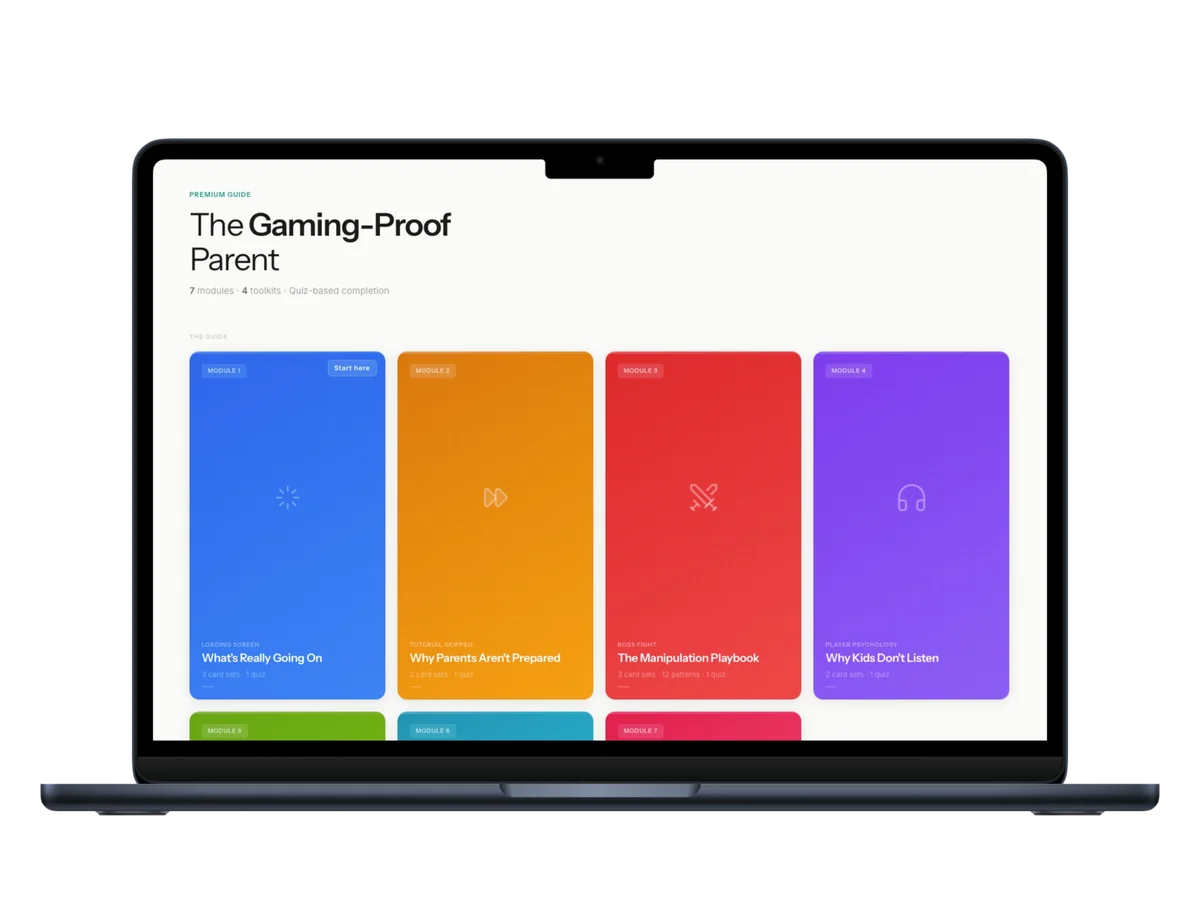
Every game your child plays is engineered to make stopping feel impossible. This guide breaks down exactly how — and gives you the conversations, the boundaries, and the 4-week plan to change it.
Want personalised help instead?
The guide gives you the system. A session gives you a plan built around your child, your family, and your specific situation. One call. 45 minutes. Everything changes.
Questions Parents Ask About Night Gaming
Sources & Further Reading
- World Health Organization — Gaming Disorder (ICD-11, 6C51)
- American Academy of Pediatrics — Media and Children
- NHS Every Mind Matters — Is My Child Spending Too Much Time Online?
- The Washington Post — Kids, Parents & Tech Help (November 2025)
- Sleep Foundation — Screen Time and Insomnia in Children